Ronald Brownstein, a senior editor at The Atlantic, coins a new political-geographic term in the wake of the Georgia U.S. Senate runoff elections to describe a shift in the political alignment of nearly all large metropolitan areas in the nation.


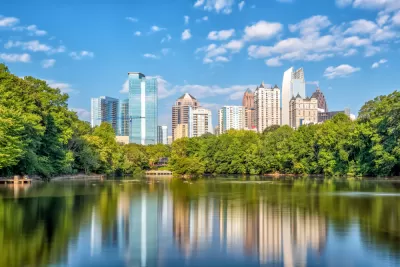
"In a state that hasn’t elected a Democratic senator since 2000, Democrats now appear to have elected two on a single day by dominating the largest population centers, particularly the Atlanta metropolitan area, with the help of powerful turnout among Black voters," writes Ronald Brownstein, a senior editor at The Atlantic, on Jan. 6.
The electorate’s strong movement toward Democrats in more populous places allowed the longtime pastor and activist Raphael Warnock to oust the GOP Senator Kelly Loeffler, and also propelled fellow Democrat Jon Ossoff to a relatively narrow but likely insurmountable lead over the Republican Senator David Perdue.
Brownstein, also a CNN senior political analyst, goes on to examine the demographic underpinnings of the historic election, but first, some background.
The two runoff elections, held on Jan. 5 as a result of no candidate receiving at least 50% of the vote on Nov. 3, 2020, resulted in narrow victories for both Democratic challengers.
"Warnock will make history when he becomes Georgia's first Black senator and the first Black Democrat to represent a southern state in the Senate," notes CNN. Ossoff will become "the first Jewish senator from Georgia and will be the youngest sitting U.S. senator at age 33," notes NPR.
It will take several days for the Georgia runoffs to be officially certified, so they will not take office immediately. Warnock's term lasts only two years, but Ossoff has won a full six year term in the Senate.
The Senate would be evenly divided between Democrats and Republicans, but once sworn in as vice president, Kamala Harris would have the power to break ties for Democrats.
Geographic show-down?
"The Democratic candidates succeeded despite solid majorities, and even relatively large turnout, for the two Republicans in exurban, small-town, and rural areas where Trump remains revered," adds Brownstein, who goes on detail characteristics of the urban-rural political divide. Italics added below.
President Trump has virtually exiled the GOP from the fast-growing, economically dynamic urban centers and inner suburbs in almost every state—powering historic levels of turnout against him among young people and minority voters (despite gains in some Black and Latino communities), and repelling many previously Republican-leaning college-educated white voters.
In effect, as Georgia’s results underscored, Trump has accelerated the emergence of what could be called the blue beltway: a growing Democratic tilt nationwide in the racially diverse, well-educated (and in many cases more religiously secular) city centers and inner suburbs of large metropolitan areas in nearly all corners of the country. That electoral shift predated Trump, but he has significantly intensified it.
The political and economic geographic divide was also evident in November when "Biden won 91 of the country’s 100 largest counties, and though he won only about one-sixth of the nation’s counties overall, his accounted for fully 71 percent of the country’s total economic output, according to calculations by the Brookings Institution," adds Brownstein.
Democrats should be wary, though, because it's "an open question whether this 'revolution' in Democratic strength across the nation’s inner suburbs will stick once Trump leaves the White House," notes Brownstein.
Hat tip to CNN's coverage of Georgia's U.S. Senate runoff election.
Related in Planetizen:
-
Election Post-Mortem: Politics Trumps Public Health, November 9, 2020
-
Election 2019: Changing Demographics Explain Democrats' Victory in Virginia, November 12, 2019
Read the full story: The Price Republicans Paid in Georgia


What Biden's Win Could Mean for Land Use, Transportation, and Climate
Campaign in poetry and govern in prose, the saying goes. Now that the reality of a Biden presidency is settling in, what does it mean for how the United States plans its future?
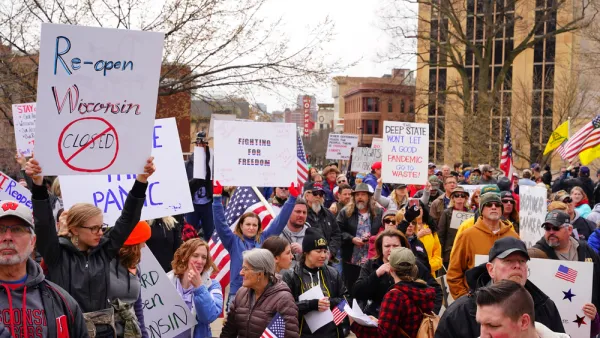
Election Post-Mortem: Politics Trumps Public Health
An analysis by the Associated Press found that voters in counties that are disproportionately impacted by the coronavirus were far more likely to support President Trump's reelection than voters in less-impacted counties.

Election 2019: Changing Demographics Explain Democrats' Victory in Virginia
It's not suburbs vs. cities but inner vs. outer suburbs that determined the outcome of elections in Virginia last Tuesday that flipped the General Assembly from red to blue.

Planetizen Federal Action Tracker
A weekly monitor of how Trump’s orders and actions are impacting planners and planning in America.

Amtrak, CN end decades-long dispute with eight-year agreement
The new operating agreement establishes an updated framework for the companies to work together, including processes to resolve disputes.

Northwest rail fans eager for Sept. 30 debut of Amtrak’s Airo fleet
Get ready for that new train smell and more seats. But they won’t go faster or run more frequently on the Cascades route in Washington and Oregon.

Brightline Florida files for bankruptcy
The transit company is over $5 billion in debt.

St. Louis Metro to test if single-car trains can reduce operating costs, maintain rider satisfaction
The pilot program will run from October to spring 2027, and begin with one single-car train operating on Metrolink’s Red and Blue lines.

Pennsylvania is building data centers in abandoned mines
Housing data centers in mines provides an alternative to destroying local forests and may spare residents from data centers’ noise and air pollution.

FREE Course: Walkable City 1: Why Walkability?
After describing his path towards focusing on walkability as the essence of good planning, Jeff Speck marches through his five principal reasons for making more walkable places.
Reinventing Malls: Planning Alchemy—Turning Gray Fields Into Gold
The course focuses on the opportunities and imperatives that shape reinvention of mall sites.

City of Thousand Oaks
City of Wisconsin Rapids
Harvard University Graduate School of Design
The Architects Foundation
University of Cincinnati Online
The Pocatello Development Authority
The Urban Renewal Agency of the City of Pocatello