The Colorado Department of Transportation is no longer considering center-running bus lanes for Colorado Boulevard.


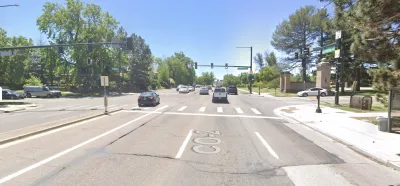
The Colorado Department of Transportation is no longer considering center-running bus lanes as a way to introduce bus rapid transit on Colorado Boulevard — and seemingly everyone is unhappy about it. Transit advocates say CDOT removed the center lane option prematurely, while opponents of BRT say that CDOT didn't go far enough, and needs to scrap the BRT plans entirety.
CDOT is still considering priority signals for buses, and side-running bus lanes, as ways to bring BRT to Colorado Boulevard. Glendale City Manager Chuck Line said these options would still create “‘the Great Wall of Colorado Boulevard’ for anyone traveling east and west,” Marc Sallinger writes for 9 News.
Meanwhile, transit advocates such as Greater Denver Transit and the Denver Streets Partnership are urging the city to wait until it has more data before removing center lanes as an option for Colorado Boulevard.
Read the full story: CDOT drops center bus lanes for Colorado Boulevard, leaving both sides of the BRT fight unhappy
Colorado Lawmakers Move to Protect BRT Funding
In the face of potential federal funding cuts, CDOT leaders reasserted their commitment to planned bus rapid transit projects.
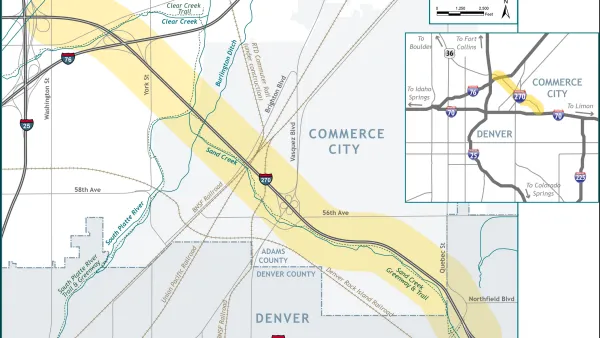
Colorado DOT To Study Air Quality Near I-270 Project—Residents Are Skeptical
The Colorado Department of Transportation has pledged to evaluate direct mitigation measures to reduce the impact of construction projects on nearby communities.
One of Denver’s busiest corridors to gain BRT
The project will span 18 miles and contain 74 bus rapid transit stations.

Planetizen Federal Action Tracker
A weekly monitor of how Trump’s orders and actions are impacting planners and planning in America.

Eastern Nebraska is running out of electricity
Data centers and electrification are straining eastern Nebraska’s grid, throttling economic development.

Study reveals best places in the U.S. for cycling, walking
New research from Streetlight Data examines bicycle and pedestrian miles per capita in the 100 largest U.S. cities by population.

All sides of BRT debate unhappy with CDOT’s most recent move
The Colorado Department of Transportation is no longer considering center-running bus lanes for Colorado Boulevard.

Massachusetts bogs generate both power, and cranberries
Putting solar panels above farmland is one way Massachusetts is advancing toward its goal of net-zero carbon emissions by 2050.

What could the future of LA transit look like under Raman?
The mayor-elect views broken sidewalks and potholes as crises that can be fixed with better governance.

FREE Course: Walkable City 1: Why Walkability?
After describing his path towards focusing on walkability as the essence of good planning, Jeff Speck marches through his five principal reasons for making more walkable places.
Reinventing Malls: Planning Alchemy—Turning Gray Fields Into Gold
The course focuses on the opportunities and imperatives that shape reinvention of mall sites.

City of Rosemead
Rutgers University, Edward J. Bloustein School of Planning and Public Policy
One Hundred Miles
University of Michigan School for Environment and Sustainability (SEAS)
Hunter College, City University of New York (CUNY)
The Architects Foundation
City of Cambridge
The Pocatello Development Authority
The Urban Renewal Agency of the City of Pocatello