The federal government is finally ready to explore technology that could saves thousands of lives every year on the highways and streets of the United States.


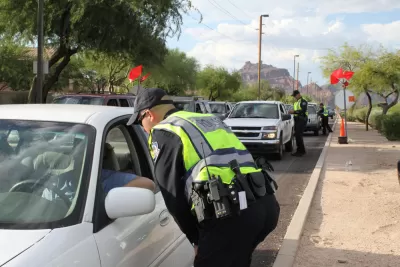
"[T]he National Highway Traffic Safety Administration quietly issued a request for information on late- or end-stage automotive technology that detects when drivers are impaired and prevents them from starting their cars," reports Kea Wilson.
The request is a very early preliminary first step toward the potential requirements for automakers to include potentially life-saving devices in vehicles, and, according to Wilson, "it’s a promising sign that the NHTSA is at least exploring the easily available solutions to our national drunk driving epidemic…"
There are many solutions to drunk driving made possible by technology that go far beyond a breathalyzer-actuated ignition. Alcohol detection technologies include on-board sensors to detect alcohol on the driver's breath or on the driver's skin. A concept car made by Nissan includes technology that detects erratic driving behavior consistent with drunk driving.
"But," writes Wilson, "like seatbelts and airbags before them, federal agencies like NHTSA have been reluctant to require the life-saving devices on new vehicles due to pressure from the auto industry, which does not want to pay the costs of implementing the reform."
FULL STORY: Feds to (Finally) Explore Drunk Driving Prevention Tech


Let’s End Traffic Stops
The technology to make traffic enforcement obsolete is becoming available. But in the U.S. willing to use it?
Deaths of Seven Motorcyclists Results in Resignation of Motor Vehicle Registry Chief
A pickup truck driver towing a trailer on a two-lane rural road in New Hampshire on June 21 is charged with seven counts of vehicular homicide after colliding with a group of motorcycle riders. Attention has turned to his commercial driver's license.
A 'Call to Action' to Find Reasons for Increase in Traffic Fatalities
The U.S. Department of Transportation wants to hear from the public to help explain the 35,092 traffic deaths last year, an increase of 2,348 people from 2014. It has issued a 'call to action' to help interpret the data.

The state-sanctioned urbicide of Austin
People don’t kill cities. Freeways do.

US to reduce Colorado River water deliveries to Mexico
A new Colorado Treaty amendment reduces Mexico’s Colorado River water allocation by 250,000 acre feet.

New Jersey’s second-largest city bans standalone data centers
Jersey City will continue to allow co-location facilities, such as those meant for research institutions that store their own data.

Amtrak not solely to blame for New Jersey commuter rail's unreliability, report finds
A new study from the Garden State Initiative found that NJ Transit’s budget grew 20% across a 4 year period, but reliability declined significantly over the same period.

EPA erases limits on planet-warming pollution from power plants
Under Monday’s plan, power plants would still have some limits on how much mercury, arsenic and other contaminants they can emit.

Phoenix announces new on-demand transit service, more frequent RAPID buses
Both new services will launch in October, and are part of Phoenix's Project Effective Access Solutions for Easing Congestion.

FREE Course: Walkable City 1: Why Walkability?
After describing his path towards focusing on walkability as the essence of good planning, Jeff Speck marches through his five principal reasons for making more walkable places.
Reinventing Malls: Planning Alchemy—Turning Gray Fields Into Gold
The course focuses on the opportunities and imperatives that shape reinvention of mall sites.

Eagle County Government
Harvard University Graduate School of Design
Nashville Planning Department
The Architects Foundation
University of Cincinnati Online
The Pocatello Development Authority
The Urban Renewal Agency of the City of Pocatello
Journal of the American Planning Association