A pickup truck driver towing a trailer on a two-lane rural road in New Hampshire on June 21 is charged with seven counts of vehicular homicide after colliding with a group of motorcycle riders. Attention has turned to his commercial driver's license.


The horrific crash last Friday serves as a reminder that motorcyclists, while driving gas-powered motor vehicles, are classified as vulnerable road users, along with pedestrians, bicyclists, moped riders and people using human and battery-powered skateboards and scooters, because they are not protected by 'outside shields.'
"The images of the scene are gut-wrenching – a mangled mess of debris sprawled across Route Two in Randolph, N.H," states a reporter in a June 22 WMUR newscast on the crash.
Why Volodymyr Zhukovskyy, the 23-year-old truck driver, crossed the double yellow line, crashing head-on into a group of 22 riders on 15 motorcycles traveling in the opposite direction, is unknown, but questions are being asked as to why Zhukovskyy, a West Springfield, Mass., resident "was able to keep his commercial driver's license despite a drunken-driving arrest last month and a history of other serious traffic violations," reports Joey Garrison for USA TODAY on June 26 (source article).
Erin Deveney, registrar of the Massachusetts Registry of Motor Vehicles (RMV), a division of the Massachusetts Department of Transportation which regulates commercial driver's licenses, resigned June 25, said MassDOT Secretary Stephanie Pollack. An investigation found that "the RMV had not acted on information provided by the Connecticut Department of Motor Vehicles about a May 11 incident that should have triggered termination of this individual’s commercial driver’s license," adds Garrison.
MassDOT said the May 11 OUI [operating under the influence] violations – in which he refused a chemical test – should have triggered his commercial license to be automatically revoked under Massachusetts law. His non-commercial driver's license should have been subject to a seven-day notification process for suspension.
Garrison goes on to describe a "communication breakdown" between the Connecticut DMV and the Mass. RMV. A manual review should have been initiated after an automatic notification sent by Connecticut "through the federal commercial driver's license system "was rejected due to insufficient information." The failure to perform that review appears to be the reason for Deveney's resignation.
Driver in jail
Zhukovskyy was arrested at his Massachusetts home Monday and has pleaded not guilty to the seven charges of vehicular manslaughter, reports John Bacon for USA Today. He is being held in a jail in Lancaster, New Hampshire, according to CBS Boston.
NTSB to investigate
The National Transportation Safety Board has joined the investigation. "The federal agency says it's coordinating its safety investigation with local authorities, who are doing their own investigation on the crash," reports NBC10 Boston
NHTSA crash data
In the National Highway Traffic Safety Administration (NHTSA)'s "Early Estimate of Motor Vehicle Traffic Fatalities in 2018" [pdf] released this month, motorcyclists, as well as drivers and passengers, saw a decrease in fatalities, while pedestrian deaths jumped to their highest level in almost three decades. Bicyclist fatalities increased the highest, by 10 percent.
By contrast, in 2016, the U.S. DOT reports that "motorcyclist deaths (5,286 fatalities – the largest number of motorcyclist fatalities since 2008) increased by 5.1 percent.
For more statistical crash data on motorcycles from 2007 to 2016, see NHTSA's 9-page Traffic Safety Facts: Motorcycles [pdf].
To reinforce the inclusion of motorcyclists as vulnerable road users, the fact sheet notes (under "registration") that while motorcycles made up 3 percent of all registered vehicles in the United States in 2016, accounting for 0.6 percent of all vehicle miles traveled, the fatality rate for motorcyclists in 2016 was six times the fatality rate for passenger car occupants.
Related in Planetizen:
- It's not Zero, But Traffic Deaths Decreased Last Year in New York City, January 4, 2016: The greatest reduction in traffic deaths in 2015 occurred for those riding on two wheels:
- Bicycle fatalities dropped by 30 percent, from 20 to 14.
- Motorcyclists saw the greatest improvement: deaths reduced by over 40 percent, from 37 to 22.
Hat tip to AASHTO Daily Transportation Update.
FULL STORY: How did he still have a license? Massachusetts Registry of Motor Vehicles boss quits after crash kills 7

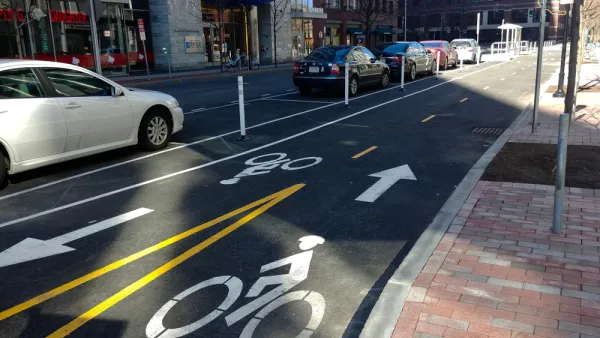
Nation's Top Safety Board Recommends Protected Bike Lanes
The NTSB chair issued a stark warning on Nov. 5: "If we do not improve roadway infrastructure for bicyclists, bicyclists will die who otherwise would not," stated Robert Sumwalt in introducing their first report in 47 years devoted to bike safety.
The Dilemma of Autonomous Vehicle Testing
Autonomous vehicles hold the potential to greatly reduce auto crashes. Advocates want them on the road as early as possible to reduce fatalities. Skeptics worry that the public will be guinea pigs during the testing—case in point: Elaine Herzberg.
DUIDs Surpass DUIs as Cause of Fatal Vehicle Crashes
2015 was the first year that driving under the influence of drugs (DUID) surpassed those killed while driving under the influence of alcohol. Increased legal access to marijuana is correlated with the surge. Amphetamine use is also a factor.

Planetizen Federal Action Tracker
A weekly monitor of how Trump’s orders and actions are impacting planners and planning in America.

The state-sanctioned urbicide of Austin
People don’t kill cities. Freeways do.

US to reduce Colorado River water deliveries to Mexico
A new Colorado Treaty amendment reduces Mexico’s Colorado River water allocation by 250,000 acre feet.

Baltimore to break ground on $50 million Transit Priority Project
The project will bring faster bus trips, safer streets and better bike connections to Baltimore.

Airbnb launches $250 million 'last-dollar financing' housing accelerator, makes first investment in Austin
The company will put $6.4 million towards affordable housing development in Texas’ capital.

Guerilla urbanists are building DIY bus stop benches in Chicago
A before-and-after of one of the bus stops with a new bench. The new benches are not officially sanctioned or permitted, but the residents who placed them hope they will be the start of a network of DIY benches across the city.

FREE Course: Walkable City 1: Why Walkability?
After describing his path towards focusing on walkability as the essence of good planning, Jeff Speck marches through his five principal reasons for making more walkable places.
Reinventing Malls: Planning Alchemy—Turning Gray Fields Into Gold
The course focuses on the opportunities and imperatives that shape reinvention of mall sites.

Eagle County Government
Harvard University Graduate School of Design
Nashville Planning Department
The Architects Foundation
University of Cincinnati Online
The Pocatello Development Authority
The Urban Renewal Agency of the City of Pocatello
Journal of the American Planning Association