BikePortland publisher and editor-in-chief Jonathan Maus took a ride along two new neighborhood greenways to report on successes and opportunities for continued improvement.


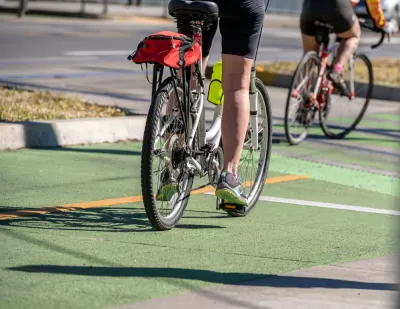
The Portland Bureau of Transportation recently completed almost seven miles of neighborhood greenway bike routes in East Portland, a part of the city that critically lacked bike infrastructure. Jonathan Maus took a bike tour of the “130s” and “HOP” projects, snapping photos along the way to illustrate the transformation.
"The lack of street grid and high speed of drivers makes every bike network investment important out there. While I focused on the crossings, what’s really great about these new greenways is how they will help people find their way between neighborhoods," Maus reflects.
The "130s," a north-south route jogging between 128th and 132nd, spans the distance between SE Foster Road and I-84 in Northeast Portland. Maus sees a new signalized crosswalk median leading to a protected bike lane at Southeast Powell Boulevard as an improvement, noting that the Outer Powell Safety Project will further improve the protected lanes. Nearing East Burnside Boulevard, "The route took me onto the sidewalk following those green dots again and then directed me over the rail tracks via a narrow sidewalk hemmed in by railings," says Maus, sharing concern about the difficulty in crossing at this intersection housing the MAX light rail.
Heading west on the "HOP" (Hassalo/Holladay-Oregon-Pacific) greenway, Maus navigated to the Gateway Transit center. "I found the eastern end of the HOP disappointing. I didn’t find any clear connection to the transit center itself. I mean, this is a major transit center and the bikeway just seemed to fizzle out," Maus says.
Among key takeaways from the ride, Maus cites inconsistencies in sidewalk routing treatments and proximity to high-speed traffic on arterials. " It doesn’t matter how good our low-stress greenways are if the crossings are high-stress. A chain is only as strong as its weakest link, remember?"
Read the full story: Taking a ride on east Portland’s new neighborhood greenways
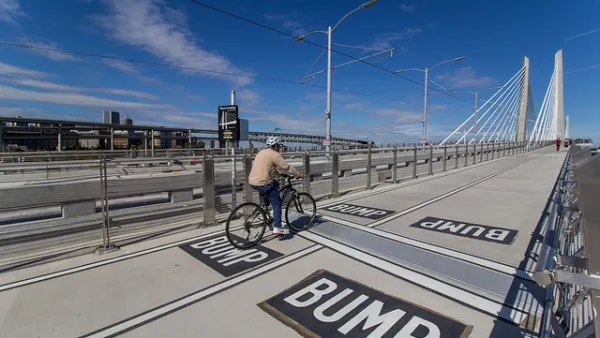
Portland and Multnomah County Push for Lower Speed Limits on Bridges
The Portland Bureau of Transportation and Multnomah County agree on a 30 mph speed limit on five downtown bridges, but the state's department of transportation denied the change on two key spans.
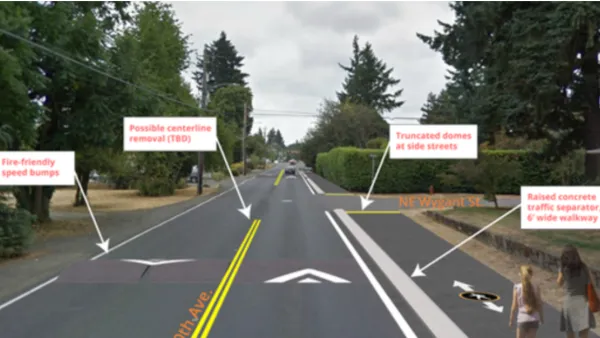
Portland Installs 'Alternative Pedestrian Walkway'
The walkway is simpler and faster to build than a sidewalk, letting the city quickly and cost-effectively improve pedestrian safety on important walking corridors.
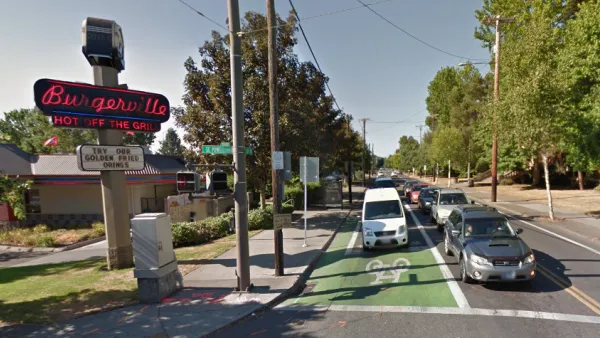
Making Protected Bike Lanes the Design Standard
An institutional mandate isn't enough to make a design vision a reality. Portland is working on bringing its standards and guidelines in line with its ambition for protected bike lanes.

Planetizen Federal Action Tracker
A weekly monitor of how Trump’s orders and actions are impacting planners and planning in America.

California plans to bury El Niño’s downpour
If the state plays its cards right, it may be able to store a billion acre-feet of El Niño’s water in aquifers.

Desperate measures: Advocates weigh draining Lake Powell to fill Colorado River
Draining the reservoir could reduce evaporation losses by a couple hundred thousand acre-feet.

In Texas, data centers are swallowing promised parkland
Residents who moved to Taylor, Texas for a rural community now have to contend with three data centers in their backyard.

How a Chicago-sized wind farm beat the odds and powered on
The project spanned five presidential administrations and a standoff with a U.S. military base.

MTA gives itself 30 days to transform pit into basketball court
The site has been under construction since 2022; the city originally estimated it would finish the court in 2024.

FREE Course: Walkable City 1: Why Walkability?
After describing his path towards focusing on walkability as the essence of good planning, Jeff Speck marches through his five principal reasons for making more walkable places.
Reinventing Malls: Planning Alchemy—Turning Gray Fields Into Gold
The course focuses on the opportunities and imperatives that shape reinvention of mall sites.

City of Rosemead
Rutgers University, Edward J. Bloustein School of Planning and Public Policy
One Hundred Miles
Hunter College, City University of New York (CUNY)
The Architects Foundation
University of Cincinnati Online
City of Cambridge
Montrose County
The Pocatello Development Authority