Public health experts assert that to safely reopen the economy, the coronavirus needs to be contained. In Manhattan, where the virus is largely controlled, chain restaurants are closing while their sister stores in Florida are expanding.



Florida has the nation's second-highest COVID-19 case incidence rate, with daily new cases of 30.3 per 100,000 people on Aug. 13, according to Harvard's COVID-19 Risk Level Map (described here) based on a 7-day moving average. Only Georgia is higher, with 33.8 cases per 100k people.
New York State's case incidence is almost one-tenth the rate that of Florida: 3.2 per 100k people. In Manhattan, the incidence rate is 3.5 daily cases per 100k people. Only Maine, Vermont, New Hampshire and Connecticut, respectively, are lower. But from a business perspective for some restaurants, the virus level might as well be irrelevant.
"Michael Weinstein, the chief executive of Ark Restaurants, who owns Bryant Park Grill & Cafe and 19 other restaurants, said he will never open another restaurant in New York, report Matthew Haag and
Of Ark Restaurants’ five Manhattan restaurants, only two have reopened, while its properties in Florida — where the virus is far worse — have expanded outdoor seating with tents and tables into their parking lots, serving almost as many guests as they had indoors.
“There’s no reason to do business in New York,” Mr. Weinstein said. “I can do the same volume in Florida in the same square feet as I would have in New York, with my expenses being much less.
Indoor dining is still not allowed in Manhattan, even with its low case incidence level. Gov. Andrew Cuomo, unlike some of his counterparts in other states, is extremely cautious in reopening New York. The first of four criteria noted on the "Metrics to Guide Reopening New York" for any of the ten regions [pdf] to reopen is that "the infection rate is sufficiently low."
According to a recent New York Times opinion co-written by a public health expert and an investment banker, New York is still not ready to fully reopen.
"We believe the choice is clear" opine Michael T. Osterholm, director of the Center for Infectious Disease Research and Policy at the University of Minnesota, and
"We can continue to allow the coronavirus to spread rapidly throughout the country or we can commit to a more restrictive lockdown, state by state, for up to six weeks to crush the spread of the virus to less than one new case per 100,000 people per day."
Going by the Osterholm/Kashkari standard, only Maine, with 0.9 cases per 100k people, met that reopening metric on Aug. 13, 2020.
Related in Planetizen:
-
California Rolls Back, July 14, 2020
Hat tip to The New York Times Coronavirus Briefing.
FULL STORY: Retail Chains Abandon Manhattan: ‘It’s Unsustainable’

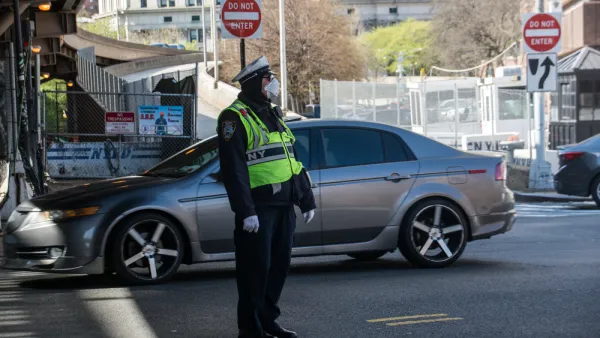
Reopening New York, New Jersey and Connecticut: Is May 19 Too Soon?
Coronavirus cases, hospitalizations and deaths are dropping in the U.S. Govs. Andrew Cuomo, Phil Murphy, and Ned Lamont jointly announced on May 3 that their states would lift most restrictions on May 19. Experts and residents have mixed reactions.
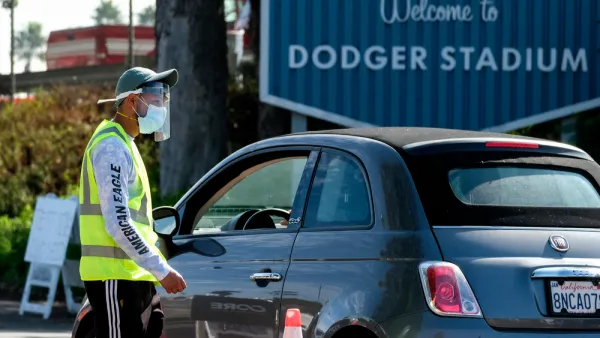
'By the Numbers': California Shows How to Reopen Safely
Unlike other states that lifted restrictions statewide after coronavirus cases plummeted, California replaced its regional stay-home order with a county-based blueprint, permitting counties to advance based on performance in three health metrics.

An American Urban Coronavirus Success Story
The City by the Bay has joined eight largely rural counties in California by advancing last Tuesday to the least restrictive tier of the state's new reopening criteria by reducing coronavirus transmission to nearly New York levels.

Planetizen Federal Action Tracker
A weekly monitor of how Trump’s orders and actions are impacting planners and planning in America.

The state-sanctioned urbicide of Austin
People don’t kill cities. Freeways do.

US to reduce Colorado River water deliveries to Mexico
A new Colorado Treaty amendment reduces Mexico’s Colorado River water allocation by 250,000 acre feet.

Mamdani overhauls NYC's Vision Zero plan with 100 new policy goals
The overhaul aims to reduce traffic deaths and make streets safer for pedestrians, cyclists and drivers through lower speed limits, new safety infrastructure and more.

Amtrak not solely to blame for New Jersey commuter rail's unreliability, report finds
A new study from the Garden State Initiative found that NJ Transit’s budget grew 20% across a 4 year period, but reliability declined significantly over the same period.

EPA erases limits on planet-warming pollution from power plants
Under Monday’s plan, power plants would still have some limits on how much mercury, arsenic and other contaminants they can emit.

FREE Course: Walkable City 1: Why Walkability?
After describing his path towards focusing on walkability as the essence of good planning, Jeff Speck marches through his five principal reasons for making more walkable places.
Reinventing Malls: Planning Alchemy—Turning Gray Fields Into Gold
The course focuses on the opportunities and imperatives that shape reinvention of mall sites.

Eagle County Government
Harvard University Graduate School of Design
Nashville Planning Department
The Architects Foundation
University of Cincinnati Online
The Pocatello Development Authority
The Urban Renewal Agency of the City of Pocatello
Journal of the American Planning Association