A new grant program launched by the Oregon Department of Transportation (ODOT) aims to fill a key gap in the funding available for bike and pedestrian paths.


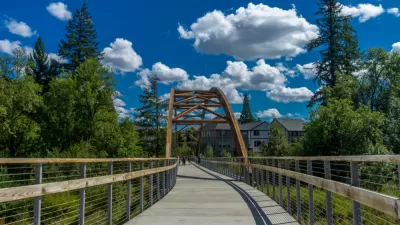
"The Oregon Department of Transportation has taken the wraps off a new program that will fund off-street path projects across the state," reports Jonathan Maus.
The Oregon Community Paths program, as the new funding program is called, could offer around $19.2 million between federal and state sources through 2024, although that total is subject to some fluctuation depending on budget tightening connected to the economic depression caused by the pandemic.
"ODOT will pull together four funding sources — one from the federal government, three from the State of Oregon — to help plan and construct paths that are not on the roadway right-of-way," according to Maus. "That stipulation is important because Highway Trust Fund, gas tax, and nearly every other major revenue source is legally required to be spent in the right-of-way."
So, for example, safe routes to school that potentially use paths that are not on the roadway, exempted from Highway Trust Fund spending, would be able to seek funding from the new Oregon Community Paths program, according to Maus.
Maus provides additional details on the four kinds of funding fueling the new program, as well as the project types that will be eligible to apply for the new funding. The program website includes more details about the funding schedule. Webinars providing more information about the program are scheduled for August 21 and September 18.
FULL STORY: ODOT says new Community Paths grant program could dish out over $19 million

Oregon Transportation Bill Saves 500 ODOT Jobs, but Leaves Future Funding Uncertain
A bill passed in a special legislative session will raise over $4 billion for transportation and public transit in the next 10 years, but fails to establish a long-term funding solution.
Indy Neighborhood Group Builds Temporary Multi-Use Path
Community members, aided in part by funding from the city, repurposed a vehicle lane to create a protected bike and pedestrian path for the summer season.
The Unceremonious Death of a Freeway Expansion Project
The end of an Oregon freeway project didn't get much fanfare, but the victory is worth celebrating.

Planetizen Federal Action Tracker
A weekly monitor of how Trump’s orders and actions are impacting planners and planning in America.

The state-sanctioned urbicide of Austin
People don’t kill cities. Freeways do.

US to reduce Colorado River water deliveries to Mexico
A new Colorado Treaty amendment reduces Mexico’s Colorado River water allocation by 250,000 acre feet.

LA Metro’s ultimatum: no extra buses for LA28 if federal funding isn’t imminently secured
If Metro does not provide additional buses, LA28 organizers will have to find a new way to manage Olympic traffic. LA28’s budget does not include a line item for transit.

Colorado’s Largest Data Center Could Rise Next to Homes — Without a Public Hearing
The proposed campus would consume 11 times the power of Denver International Airport; as it has across the country, opposition mounts.

5 New England states march closer to 800 megawatt wind energy project
Securing federal approval for the project may be complicated under the Trump administration, which has historically been hostile towards domestic wind power.

FREE Course: Walkable City 1: Why Walkability?
After describing his path towards focusing on walkability as the essence of good planning, Jeff Speck marches through his five principal reasons for making more walkable places.
Reinventing Malls: Planning Alchemy—Turning Gray Fields Into Gold
The course focuses on the opportunities and imperatives that shape reinvention of mall sites.

Eagle County Government
Harvard University Graduate School of Design
Nashville Planning Department
The Architects Foundation
University of Cincinnati Online
The Pocatello Development Authority
The Urban Renewal Agency of the City of Pocatello
Journal of the American Planning Association