The Trump administration didn't just dismantle an Obama-era fair housing rule—it replaced it with a new policy of its own called Preserving Community and Neighborhood Choice.


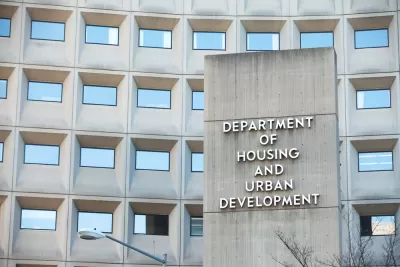
As documented repeatedly by Planetizen, the Trump administration recently dismantled the Affirmatively Furthering Fair Housing (AFFH) rule, a policy adopted by the Obama administration to provide more effective enforcement of the Fair Housing Act of 1968.
The policy that the Trump administration has chosen to replace the AFFH rule is called the Preserving Community and Neighborhood Choice (PCNH) rule, which the the National Council of State Housing Agencies (NCSHA), is on the record describing as a requirement for U.S. Department of Housing and Urban Development grantees to certify that the use HUD funds will actively promote fair housing.
A few additional articles published at the end of July offer additional insight for how the Trump administration intends to enforce fair housing laws, starting with an article by Matthew Choi for Politico, who includes this explanation of the new rule amidst an article that mostly focuses on the pro-segregationist stance now given full and vocal support by the president of the United States:
The Department of Housing and Urban Development announced a replacement policy last week that essentially leaves localities to self-certify that housing is affordable and free of discrimination — a significant scale-down of the Obama-era rule.
“After reviewing thousands of comments on the proposed changes to the [AFFH] regulation, we found it to be unworkable and ultimately a waste of time for localities to comply with, too often resulting in funds being steered away from communities that need them most,” HUD Secretary Ben Carson said last week.
Another article by Sean Keenan for the SaportaReport shares insight from experts in the Atlanta area about the effect of the Preserving Community and Neighborhood Choice (PCNH) rule.
Experts have pointed out to SaportaReport that the move seems to allow local governments to let developers concentrate low-income housing projects in pockets of poverty and keep them clear of uninviting wealthy suburbs, clashing with the conventional wisdom that says spreading out affordable housing in areas with varying income levels is crucial to combating income inequality, eliminating food deserts and diversifying communities.
Among the commentary shared in Keenan's article is a warning from Georgia State University urban studies professor Dan Immergluck, who says that the Trump administration shouldn't be expected to stop with the AFFH in dismantling the federal government's ability to enforce fair housing laws.
FULL STORY: Trump boasts of pushing low-income housing out of suburbs


Outrage Over Trump's Fair Housing Victory Lap
President Trump took to Twitter today to celebrate his administration's decision to rescind the Affirmatively Furthering Fair Housing rule, approved by the Obama administration to strengthen the Fair Housing Act of 1968.
Trump Administration Proposal Would Eliminate Fair Housing Protections
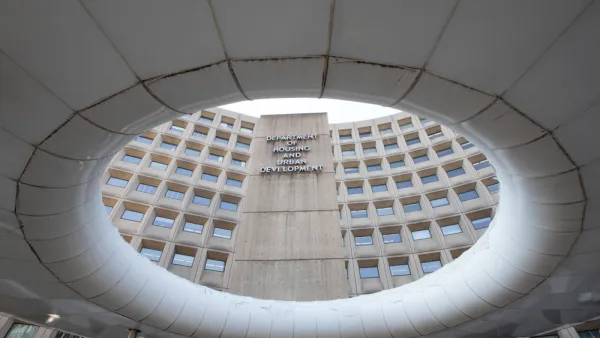
The Trump administration last week published its latest attempt to undermine a fair housing rule adopted during the Obama administration.
Biden Promises New Attention to Racial Inequality, Including Fair Housing
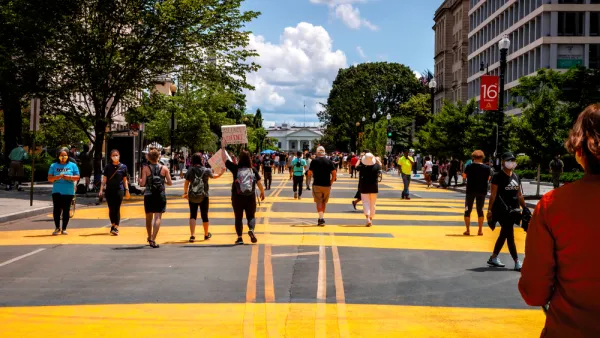
The Biden administration is announcing its intentions to overturn several controversial products of the Trump administration to weaken the the implementation of the Fair Housing Act of 1968 and the doctrine of disparate impact at its core.

Planetizen Federal Action Tracker
A weekly monitor of how Trump’s orders and actions are impacting planners and planning in America.

The state-sanctioned urbicide of Austin
People don’t kill cities. Freeways do.

US to reduce Colorado River water deliveries to Mexico
A new Colorado Treaty amendment reduces Mexico’s Colorado River water allocation by 250,000 acre feet.

Mamdani overhauls NYC's Vision Zero plan with 100 new policy goals
The overhaul aims to reduce traffic deaths and make streets safer for pedestrians, cyclists and drivers through lower speed limits, new safety infrastructure and more.

Amtrak not solely to blame for New Jersey commuter rail's unreliability, report finds
A new study from the Garden State Initiative found that NJ Transit’s budget grew 20% across a 4 year period, but reliability declined significantly over the same period.

EPA erases limits on planet-warming pollution from power plants
Under Monday’s plan, power plants would still have some limits on how much mercury, arsenic and other contaminants they can emit.

FREE Course: Walkable City 1: Why Walkability?
After describing his path towards focusing on walkability as the essence of good planning, Jeff Speck marches through his five principal reasons for making more walkable places.
Reinventing Malls: Planning Alchemy—Turning Gray Fields Into Gold
The course focuses on the opportunities and imperatives that shape reinvention of mall sites.

Eagle County Government
Harvard University Graduate School of Design
Nashville Planning Department
The Architects Foundation
University of Cincinnati Online
The Pocatello Development Authority
The Urban Renewal Agency of the City of Pocatello
Journal of the American Planning Association