Unarmed public works officials could replace Berkeley Police officers in monitoring minor traffic violations pending approval of a proposal to be considered by the Berkeley City Council.


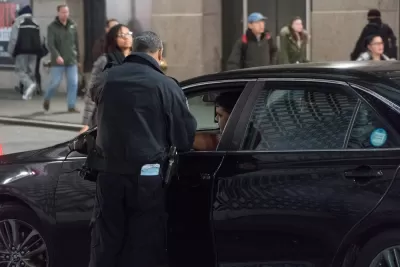
Berkeley City Council is set to consider a proposal to shift responsibility for conducting traffic stops away from the Berkeley Police Department and to unarmed public works officials. If adopted, the change will be implemented in next year's fiscal budget which also includes a $9.2 cut to the Police Department's budget, reports Kellen Browning.
Traffic stops are residents' most frequent contact with police in the United States, and Black and Hispanic drivers have historically been stopped disproportionately than whites due to racial profiling and bias. Central Connecticut State University researcher Ken Barone says that police often use stops for minor traffic offenses as justification for car searches. "Supporters of the plan point to the cases of several high-profile deaths of Black people after traffic stops, including Philando Castile, who was pulled over for a broken brake light, and Sandra Bland, who failed to signal a lane change," writes Browning.
Read the full story: How Berkeley Could Remove the Police From Traffic Stops

Chicago Police Stop Seven Times as Many Black Drivers as White Motorists
A state-produced study of traffic stops in the city reveals that traffic stops in the city have risen sharply, with Black motorists pulled over at much higher rates than their white counterparts.
The Car-Centric World and the Ongoing Expansion of Police Powers
While cars are still equated with freedom of mobility and personal liberty, they've also offered courts the chance to expand police powers in the public realm, time and time again.
Report: Federal Policies to Make Traffic Enforcement More Equitable
Recommendations for how USDOT can guide more equitable traffic enforcement that improves traffic safety and protects vulnerable populations.

Planetizen Federal Action Tracker
A weekly monitor of how Trump’s orders and actions are impacting planners and planning in America.

The state-sanctioned urbicide of Austin
People don’t kill cities. Freeways do.

Colorado’s Largest Data Center Could Rise Next to Homes — Without a Public Hearing
The proposed campus would consume 11 times the power of Denver International Airport; as it has across the country, opposition mounts.

Nation's most wind-powered state turns to coal as data centers increase energy demand
For the first time in decades, Iowa has increased its generation of coal power.

NYC cools commuters with city's first rain garden above a bus stop
New York City officials say the plants in the rain garden can absorb 16 gallons of rainwater during heavy storms.

Brightline West’s future may rely on $6 billion federal loan
The company has until Nov. 2 to make a $400 million equity investment into its proposed high-speed rail line.

FREE Course: Walkable City 1: Why Walkability?
After describing his path towards focusing on walkability as the essence of good planning, Jeff Speck marches through his five principal reasons for making more walkable places.
Reinventing Malls: Planning Alchemy—Turning Gray Fields Into Gold
The course focuses on the opportunities and imperatives that shape reinvention of mall sites.

Greater Baltimore Committee
Eagle County Government
Harvard University Graduate School of Design
The Architects Foundation
University of Cincinnati Online
The Pocatello Development Authority
The Urban Renewal Agency of the City of Pocatello
Journal of the American Planning Association