A busy corridor, popular with bike and scooter riders, is gaining a new protected bike lane in Los Angeles.


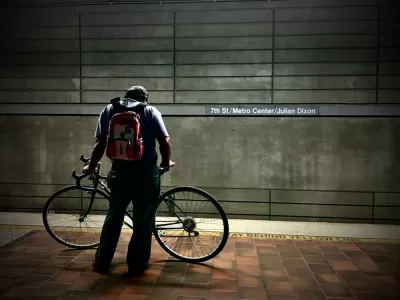
"With automobile traffic down due to the COVID-19 stay-at-home order, the City of Los Angeles took the opportunity to resurface the stretch of 7th Street between the Financial District and the Historic Core," reports Steven Sharp. "When that fresh pavement is restriped in the coming weeks, it will come with a treat for cyclists."
That treat will come in the form of a new protected bike lane--still a rare sight in Los Angeles. Though the new .6-mile-long protected bike lane will be installed with temporary fixtures like plastic bollards, the street improvements will include other features like bus stop consolidation and a parklet (the latter will be installed in August, according to the article). The bike lane will be made permanent in 2021.
Funding for the project came from the city's dockless mobility pilot program, which was once a promising revenue model for alternative transportation infrastructure. Bird canceled its infrastructure funding program in 2019 and the city of L.A.'s one-year pilot program has exceeded that window of time, but revenue generated by this still relatively new mode of transportation is still paying off. Sharp notes that the 7th Street corridor sees the highest rates of electric scooter ridership in the city.
Read the full story: Protected Bike Lanes are Coming to 7th Street
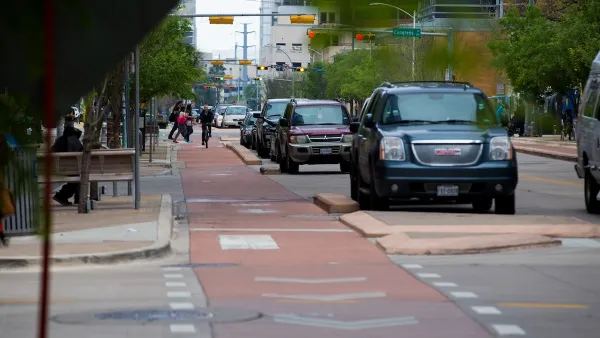
Austin Outlaws Blocking Bike Lanes
Drivers who park in bike lanes will receive citations of up to $300.
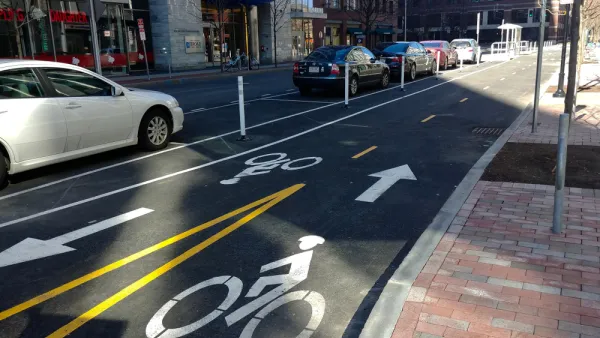
Nation's Top Safety Board Recommends Protected Bike Lanes
The NTSB chair issued a stark warning on Nov. 5: "If we do not improve roadway infrastructure for bicyclists, bicyclists will die who otherwise would not," stated Robert Sumwalt in introducing their first report in 47 years devoted to bike safety.
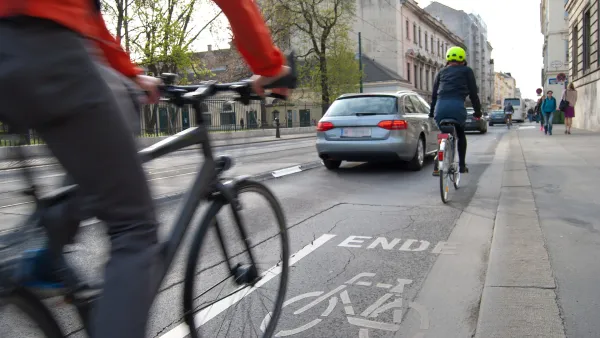
Study: Cars Give Bike Lanes Less Space
A new study provides more evidence that people on bikes need more of a buffer from drivers in cars than a mere strip of paint can offer.

Planetizen Federal Action Tracker
A weekly monitor of how Trump’s orders and actions are impacting planners and planning in America.

California plans to bury El Niño’s downpour
If the state plays its cards right, it may be able to store a billion acre-feet of El Niño’s water in aquifers.

Desperate measures: Advocates weigh draining Lake Powell to fill Colorado River
Draining the reservoir could reduce evaporation losses by a couple hundred thousand acre-feet.

Mamdani’s pied-à-terre tax survives legal challenge
A panel of judges found that the plaintiffs failed to demonstrate injury as a result of New York City's implementation of the tax.

Eastern Nebraska is running out of electricity
Data centers and electrification are straining eastern Nebraska’s grid, throttling economic development.

Seattle passes record-breaking transit services expansion
Proposition 1 will double the city’s transit tax to add 95,000 more bus trips and preserve 180,000 bus trips annually.

FREE Course: Walkable City 1: Why Walkability?
After describing his path towards focusing on walkability as the essence of good planning, Jeff Speck marches through his five principal reasons for making more walkable places.
Reinventing Malls: Planning Alchemy—Turning Gray Fields Into Gold
The course focuses on the opportunities and imperatives that shape reinvention of mall sites.

City of Rosemead
Rutgers University, Edward J. Bloustein School of Planning and Public Policy
One Hundred Miles
University of Michigan School for Environment and Sustainability (SEAS)
Hunter College, City University of New York (CUNY)
The Architects Foundation
City of Cambridge
Montrose County
The Pocatello Development Authority