(Opinion) After devoting more than a century of planning and engineering effort to the movement and storage of cars above all other considerations, U.S. cities have suddenly, temporarily shifted priorities.


It might be time to wonder if the car has finally met its match.
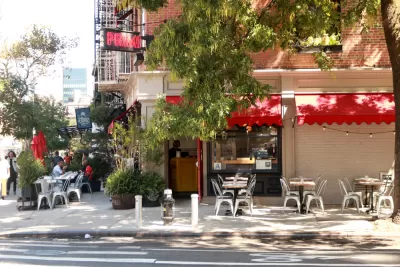
While it's so far only a temporary change, the sudden popularity of al fresco streets—a term we are using until a more universally accepted term comes along—presents undeniable evidence that some things in the United States are, for now at least, more important than allowing for the automobile's every possible convenience.
From California to Missouri to Connecticut, U.S. cities are clearing sidewalks, blocking parking spaces, closing entire streets to vehicles, and setting up shop in empty parcels to make space for outdoor retail and restaurant businesses. These changes are necessary for many local restaurant and retail businesses to survive a summer of social distancing requirements, according to the rationale behind the changes. Since the city of Vilnius, Lithuania announced plans to close streets in its downtown historic core to automobiles to allow for outdoor space to cafés, almost daily announcements of similar plans have hit the U.S. planning newswire. Where the idea hasn't achieved full political and bureaucratic backing, editorial boards and advocates are calling for more, like in Dallas, Seattle, Boston, New York, Denver, and Chicago.
Lost in some of the discussion is the significance of the al fresco streets movement in the history of urban planning in the United States. There have been very few occasions since the beginning of the 20th century that any feature other than the movement and storage of the automobile has been assigned top priority in the public and private built environment.
There are a few exceptions in a century of the car's unflinching dominance: A freeway is torn down here and there (also resulting in new, massive tunnel built to replace the lost highway capacity). A bike lane is added from time to time. Jane Jacobs achieved new levels of fame by preventing an elevated highway through Manhattan, so score one point for everything other than cars. The paint is still wet on two of the biggest pre-pandemic victories over the car-centric status quo: In 2019, New York City gave priority to buses on 14th Avenue in Manhattan and San Francisco closed Market Street to most car traffic. Two points each for everything but the car.
The sudden proliferation of al fresco streets marks a substantial advancement of the cause represented by those scattered few examples of anti-car political success. We shouldn't discount the political achievement, however fleeting, of this unprecedented shift in the balance of political power. The automobile could still end up being the long-term victor in the post-pandemic reality to come. But for now, we are witnessing history.
To create an al fresco street, politicians must legislatively approve the removal of regulations and other obstacles for outdoor operation—of which, there are many (again, the car has been king for over a century). Preceding interventions—complete streets, open streets, shared streets, tactical urbanism, play streets, slow streets, parklets, Park(ing) Day, and Better Block—have tested some of the concepts of a post-car retrofit. Variations on those previous experiments are visible in some of the examples of al fresco streets that have emerged so far.
- In Tampa, Florida, a pilot project is allowing restaurants to set up tables in car spaces on commercial corridors in multiple neighborhoods around the city.
- In Berkeley, California, the city is seeking interested participants in a program that will close streets to car traffic at peak dining times to allow restaurants to move tables out onto the street.
- Hinsdale, Illinois is blocking First Street in the city's downtown to automobile traffic to allow local restaurants to set up tables on the street.
- In St Louis, Missouri the al fresco streets concept has expanded to allow restaurants to set up tables on adjacent, vacant lots, in addition to the street. Restaurants can seek a permit for outdoor operations, free of cost.
- In Connecticut, Governor Ned Lamont released a sweeping executive order that eases the permitting process for outdoor activities and even removes minimum parking requirements to facilitate the shift to al fresco streets.
Despite the historic significance of these actions, a long-term victory over the destructive status quo of car-centric planning is far from assured. The traditional powers that be are already pushing back on the idea of turning car space over to active transportation and retail activity. In Chicago, opponents of the idea have called for bike lanes and bike parking to be converted to restaurant space. In Los Angeles, restaurants and pedestrians can have street space when they pry it from the cold, dead fingers of local drivers. The Seattle Times is hosting a digital poll on the placement of "Stay Healthy Streets" around the city of Seattle. "I do not want streets closed in my neighborhood for any reason" is in second place as of this writing, with 27 percent of the vote.
The temporary popularity of al fresco streets could become a pyrrhic victory if these changes become just another tool of privilege. Preventing the most vulnerable street users from being displaced or disenfranchised will require the participation of people traditionally left out of planning processes. Some organizations and individuals have voiced strong criticisms of al fresco streets, slow streets, and other changes in the public realm during the pandemic out of concern that necessary steps of public engagement are being skipped, and that "the implementation of these ideas is sometimes flowing along the same lines of inequity as many pre-corona planning and policy efforts," as Liz Ogbu states it in a highly recommended opinion piece for Curbed by Courtney E. Martin.
It's reasonable to assume that the world, left to its own devices, will continue to entrench and enrich the powers that be, during and after this crisis. It's clear that the treatment of street vendors and the homeless are two places to start when considering the equitable implementation of al fresco streets. Police enforcement of social distancing has also shown glaring discrepancies along racial lines in some cities, as have decisions about which parks and public spaces have stayed open, and which are closed. Public transit ridership could crater long enough to kill off transit service all over the country. If people start relying on cars for even more trips, cities could lose some of the most effective resources for social and economic mobility. If people start relying on cars for even more trips, entire cities, not just bus riders and pedestrians, will be overwhelmed with the traffic and pollution caused by cars.
Unemployment might end up being the only trend with the long-term force to prevent a more car-centric future, but that's not a scenario any compassionate person would choose. As the sudden political support for al fresco streets proves, a sustainable, healthy, and equitable recovery requires a built environment that prioritizes bike and pedestrian mobility, public transit, access for people with disabilities, and less polluted air and water.
It's wishful thinking to assume that the proliferation of al fresco streets around the United States proves anything more than a temporary reordering of priorities. But advocates for less polluted, less dangerous urban environments shouldn't let this crisis go to waste. For the first time in over a century, the car is in the backseat. It's time for someone else to do the driving.
***
P.S. The debate about streets has practically become a genre unto itself. Here's a sample that we'd be remiss not to find a place for few more of them in the Planetizen archive:
- Dear cities: Don’t miss this once-in-a-lifetime opportunity to remake and retake streets (Kinder Institute for Urban Research, April 25)
- Will COVID-19 change the parking business? (The Hustle, April 26)
- Are we witnessing the death of the car? (Future Planet, April 29)
- Coronavirus has shown us a world without traffic. Can we sustain it? (Brookings, May 1)
- Streets Should Be Car-Free During Lockdown. And After. (The New York Times, May 1)
- Houston’s transportation planner: COVID shows streets cannot be just for commuting (Houston Chronicle, May 8)
- Don’t Close Parks. Open Up Streets. (The Atlantic, May 10)
- Which will dominate our cities after the coronavirus, bikes or cars? (Treehugger, May 11)
- Cities Have a Small Window to Save Themselves From Cars (Slate, May 14)
- Will Clear Roads and Clean Skies Outlast the Pandemic? (Sightline Institute, May 15)
- Slow streets are the path to a better city (Curbed May 19)

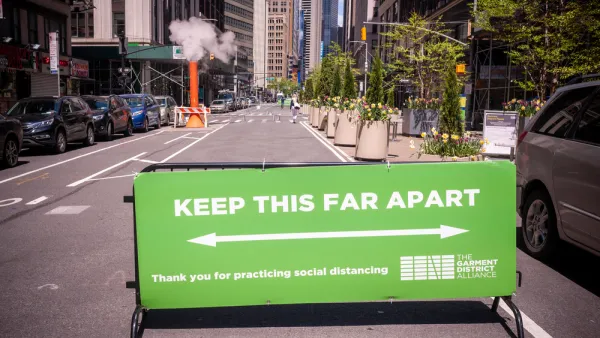
Pandemic Planning Must Reconcile With the Inequities of the Past
The ongoing debate about the role of marginalized communities in the emergency planning programs of the pandemic has now been detailed on the pages of the New York Times.
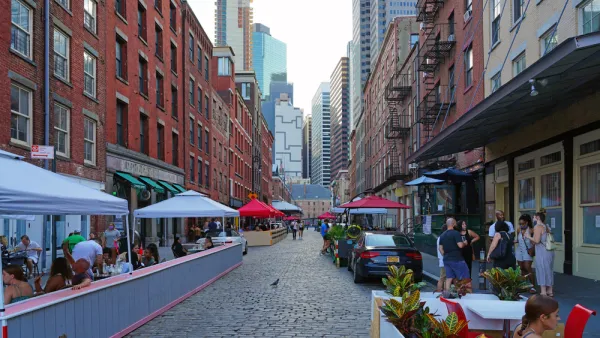
Cities Rethinking the Value of Parking
The effort to reclaim public and private spaces from car storage had some setbacks since the days of al fresco and open streets in the first years of Covid-19. But widespread parking reforms and new evidence shows the public is rethinking parking.
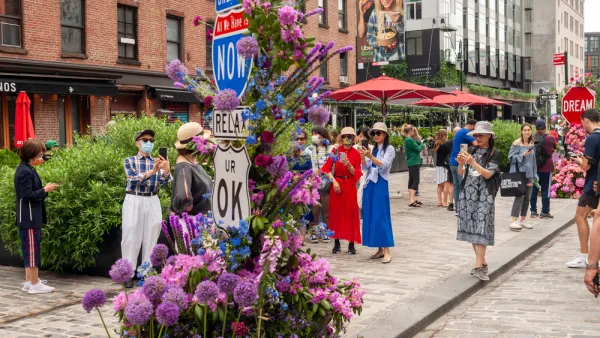
The Tide Has Turned Against Open Streets
Once a promising development for advocates pushing for a less car-centric future in cities, the open streets movement has ceded significant ground to cars since the height of the pandemic.

Planetizen Federal Action Tracker
A weekly monitor of how Trump’s orders and actions are impacting planners and planning in America.
Northwest rail fans eager for Sept. 30 debut of Amtrak’s Airo fleet
Get ready for that new train smell and more seats. But they won’t go faster or run more frequently on the Cascades route in Washington and Oregon.
Trump is considering data centers on 6 states' public land — some state officials say they had no idea
If the administration approves the proposed projects, data center and data center-related developments will cover 17,600 acres of public land.

After decades of planning, Sacramento gains new light rail station
Trains will arrive every 15 minutes during peak hours and every 30 minutes during non-peak hours.

Massive tunnel-boring machine breaks ground on Gateway Project
The Trump administration revoked funding for the project in October 2025, and then restored it earlier this year.

Airo trainsets begin service on Amtrak Cascades route
The trains feature panoramic windows, complementary wifi and over 300 seats per train set.

FREE Course: Walkable City 1: Why Walkability?
After describing his path towards focusing on walkability as the essence of good planning, Jeff Speck marches through his five principal reasons for making more walkable places.
Reinventing Malls: Planning Alchemy—Turning Gray Fields Into Gold
The course focuses on the opportunities and imperatives that shape reinvention of mall sites.

City of Thousand Oaks
City of Wisconsin Rapids
Harvard University Graduate School of Design
The Architects Foundation
University of Cincinnati Online
Northern Illinois Transit Authority (NITA)
The Pocatello Development Authority
The Urban Renewal Agency of the City of Pocatello

