Could New York City follow in the footsteps of...Vilnius?


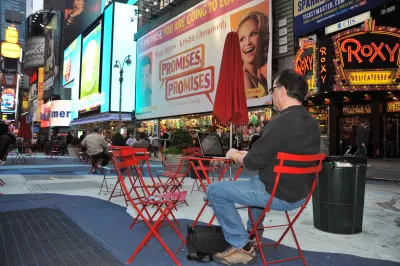
After the Lithuanian capital city of Vilnius announced a plan to open 18 public open spaces in the historic core to al fresco dining and cafe uses, the idea has traction among prominent media outlets in New York City.
Tanay Warerkar writes for Eater New York to report that city officials are actually already pondering the idea, inspired not by Vilnius, but by the city's plan to open 100 miles of city streets to pedestrian and bike priority.
The possibility of moving restaurant seating to the streets was a question raised by a WNBC reporter at the Mayor’s press conference on Monday, an idea that de Blasio called “interesting.” The administration has “thought about it” and “begun discussions,” he said, though he added that it’s too early to unveil any plans. He went on to say that “there could be advantages to having more of it [restaurant seating] be outdoors.”
Writing for Slate, Henry Grabar expands the Vilnius model for consideration far beyond New York City, finding examples of cities already making new space for outdoor dining in space once reserved for cars. For instance:
In Brookhaven, a suburb of Atlanta, Mayor John Ernst has given restaurants permission to turn their parking into restaurant space. “For the next 90 days, Brookhaven will embrace alfresco dining,” he said.
Grabar's article concludes with the recommendation for choosing restaurants over cars in the wake of the pandemic—another version of the many choices facing U.S. communities as the the process of reopening the economy and daily lives threatens to significantly impact the patterns of daily life to the detriment of the environment and social and economic equity.
FULL STORY: NYC’s Restaurant Reopening Could Include Outdoor Seating On Closed Streets

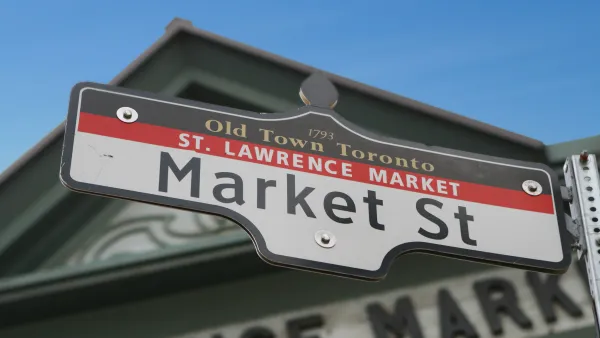
A Car-Free Summer on Toronto’s Market Street
The I Heart Market Street program will allow pedestrians a car-free space adjacent to Toronto’s St. Lawrence Market.
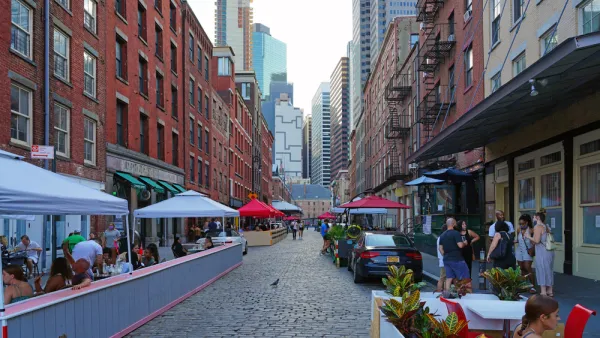
Open Streets and Outdoor Dining Are Best for Business, Report Says
Most business owners believe that they'd be out of business without on-street parking near their front door. The experience of New York City during the pandemic proves otherwise.
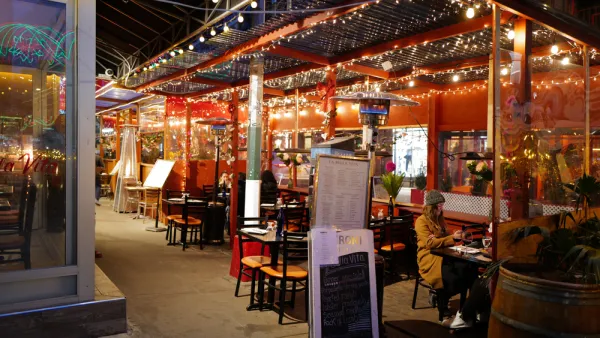
Who Should Manage New York’s Outdoor Dining Program?
A proposal to shift responsibility away from the Department of Transportation has met staunch resistance from industry groups and advocates of the program.

Planetizen Federal Action Tracker
A weekly monitor of how Trump’s orders and actions are impacting planners and planning in America.

The state-sanctioned urbicide of Austin
People don’t kill cities. Freeways do.

US to reduce Colorado River water deliveries to Mexico
A new Colorado Treaty amendment reduces Mexico’s Colorado River water allocation by 250,000 acre feet.

Baltimore to break ground on $50 million Transit Priority Project
The project will bring faster bus trips, safer streets and better bike connections to Baltimore.

Airbnb launches $250 million 'last-dollar financing' housing accelerator, makes first investment in Austin
The company will put $6.4 million towards affordable housing development in Texas’ capital.

Guerilla urbanists are building DIY bus stop benches in Chicago
A before-and-after of one of the bus stops with a new bench. The new benches are not officially sanctioned or permitted, but the residents who placed them hope they will be the start of a network of DIY benches across the city.

FREE Course: Walkable City 1: Why Walkability?
After describing his path towards focusing on walkability as the essence of good planning, Jeff Speck marches through his five principal reasons for making more walkable places.
Reinventing Malls: Planning Alchemy—Turning Gray Fields Into Gold
The course focuses on the opportunities and imperatives that shape reinvention of mall sites.

Eagle County Government
Harvard University Graduate School of Design
Nashville Planning Department
The Architects Foundation
University of Cincinnati Online
The Pocatello Development Authority
The Urban Renewal Agency of the City of Pocatello
Journal of the American Planning Association