On Monday, the 73rd World Health Assembly convenes virtually for two days. NPR's Scott Simon speaks with a WHO spokesperson about how long we can expect to live with the coronavirus that causes COVID-19.



"Typically, it takes years, up to 10 years, to develop a vaccine," Dr. Maria Van Kerkhove, an emerging diseases expert and a spokesperson for the World Health Organization (WHO), tells NPR's Scott Simon in response to his first question about the length of time needed to "create a reliable vaccine." Dr. Kerkhove adds that a vaccine to treat another coronavirus known as MERS-CoV that causes Middle East respiratory syndrome (MERS) has been in development since 2014.
Next, Simon asks whether the virus could become endemic, i.e., "is it also possible that COVID-19 will become one more persistent health problem in the world, like the flu, that people will just have to protect against and learn how to live with somehow?" Another endemic virus is HIV that causes AIDS.
"Well, it certainly could," responds Van Kerkhove. "I think what we need to remind ourselves is that this virus can be controlled. It's different than flu in that sense."
Kerkhove reminds Simon that unlike the U.S., other countries have shown how to contain the coronavirus.
"We've seen a number of countries across Asia and now in Europe, you know, who are having success at suppressing transmission by following these fundamental steps of public health of finding, testing, isolating, treating all cases. And if we can do that, if we can put that work force in place in countries, we can bring that transmission onto such a low level that we can find a way to live with this. And I think that's the balance we need to find.
In fact, that's how an earlier deadly coronavirus outbreak ended 17 years ago, only eight months after it emerged from Guangdong province, China, in late 2002, infecting 8,000 people and killing almost 800.
"The SARS (Severe Acute Respiratory Syndrome) outbreak, which reached 29 countries, was ultimately contained using traditional public health measures, such as testing, isolating patients and screening people at airports and other places where they might spread the virus, said Lawrence Gostin, director of the World Health Organization Collaborating Center on National and Global Health Law," reported the Los Angeles Times in February.
WHO emergencies expert Dr. Michael Ryan told an online briefing on May 13 much the same thing, reported Reuters.
“It is important to put this on the table: this virus may become just another endemic virus in our communities, and this virus may never go away...I think it is important we are realistic and I don’t think anyone can predict when this disease will disappear.”
On March 25, shortly after the first stay-at-home orders were issued in the U.S., Atlantic science journalist, Ed Yong, wrote an insightful piece, "How the Pandemic Will End," offering three scenarios:
- Successful suppression as with SARS in 2003 (see above). "Given how widespread the coronavirus pandemic is, and how badly many countries are faring, the odds of worldwide synchronous control seem vanishingly small."
- Following the route of its influenza predecessor 102 years ago, in which case expect up to 800,000 deaths in the U.S., and Sweden will be proven correct in striving for herd immunity.
- "The third scenario is that the world plays a protracted game of whack-a-mole with the virus, stamping out outbreaks here and there until a vaccine can be produced. This is the best option, but also the longest and most complicated."
On April 14, Yong provided more insight into what that third scenario might look like in his piece, "Our Pandemic Summer."
With luck, that will take 18 to 24 months. During that time, new outbreaks will probably arise. Much about that period is unclear, but the dozens of experts whom I have interviewed agree that life as most people knew it cannot fully return. “I think people haven’t understood that this isn’t about the next couple of weeks,” said Michael Osterholm, an infectious-disease epidemiologist at the University of Minnesota. “This is about the next two years."
Back to the source article in NPR, Van Kerkhove with WHO seems to be like-minded in her response to Simon's final question, "what keeps you up at night? What concerns you most right now about what's going on?"
"Complacency—I understand that many people would like this to be over, as will I," answers Van Kerkhove.
"But we have a long way to go. This virus is going to be with us for some time... I worry about the lifting of the so-called lockdowns in many countries. If that is done too quickly, if it is done all at once, the virus will increase. Transmission will increase. And that does worry me. But I think that we're seeing ways in which many countries are taking a data-driven approach, a controlled way in which they're lifting some of these measures. And I think we can get through this."
Related in Planetizen:
FULL STORY: WHO Official Discusses Pandemic Ahead Of World Health Assembly

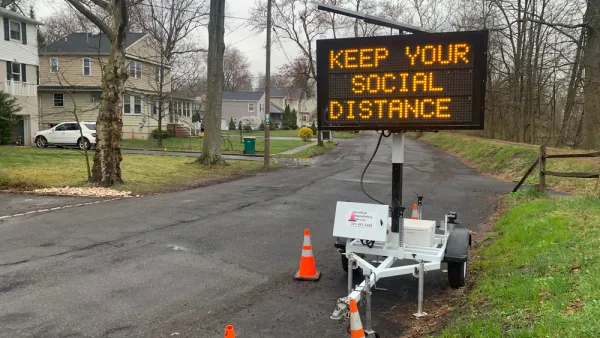
Report: Expect to Live with Two More Years of Social Distancing
As a majority of states relax stay-at-home restrictions, a prestigious team of experts from the University of Minnesota, Harvard and Tulane universities warns that the coronavirus will likely last 18 to 24 more months, returning in successive waves.

Post-Pandemic: Living with COVID
With coronavirus Infections decreasing and vaccinations increasing throughout the nation, health and science reporters are writing about what the end of the pandemic may look like—from a disease perspective.

Second Wave or Second Peak?
The terminology of the coronavirus pandemic isn't applied consistently, particularly when dealing with areas seeing a resurgence of infection after states have relaxed social distancing restrictions. The World Health Organization added some clarity.

The state-sanctioned urbicide of Austin
People don’t kill cities. Freeways do.

US to reduce Colorado River water deliveries to Mexico
A new Colorado Treaty amendment reduces Mexico’s Colorado River water allocation by 250,000 acre feet.

New Jersey’s second-largest city bans standalone data centers
Jersey City will continue to allow co-location facilities, such as those meant for research institutions that store their own data.

Amtrak not solely to blame for New Jersey commuter rail's unreliability, report finds
A new study from the Garden State Initiative found that NJ Transit’s budget grew 20% across a 4 year period, but reliability declined significantly over the same period.

EPA erases limits on planet-warming pollution from power plants
Under Monday’s plan, power plants would still have some limits on how much mercury, arsenic and other contaminants they can emit.

Phoenix announces new on-demand transit service, more frequent RAPID buses
Both new services will launch in October, and are part of Phoenix's Project Effective Access Solutions for Easing Congestion.

FREE Course: Walkable City 1: Why Walkability?
After describing his path towards focusing on walkability as the essence of good planning, Jeff Speck marches through his five principal reasons for making more walkable places.
Reinventing Malls: Planning Alchemy—Turning Gray Fields Into Gold
The course focuses on the opportunities and imperatives that shape reinvention of mall sites.

Eagle County Government
Harvard University Graduate School of Design
Nashville Planning Department
The Architects Foundation
University of Cincinnati Online
The Pocatello Development Authority
The Urban Renewal Agency of the City of Pocatello
Journal of the American Planning Association