After initially saying that he had total authority on how and when to reopen the economy, Trump handed the responsibility to the 50 governors to make their own decisions and offered guidance in the form of a three-phase plan that relies on testing.



"On a day when the nation’s death toll from the coronavirus increased by more than 2,000 for a total over 30,000, the president released a set of nonbinding guidelines that envisioned a slow return to work and school over weeks or months," report Peter Baker and
GYMS can open if they adhere to strict physical distancing and sanitation protocols. BARS should remain closed."
Lack of testing
"Any effort by states to begin to ease restrictions requires an expanded testing capacity to give people a sense of security, health experts say, and the country is far behind in conducting enough tests to responsibly inform those decisions," according to the Times.
Vice President Mike Pence asserted on Friday that the United States currently has the testing capacity to allow all states to move to begin the first phase of the White House’s guidelines for reopening their economies.
Dr. Anthony Fauci, the federal government’s top infectious disease expert, said that “existing capacity” for testing nationwide can be utilized, but used the future tense when discussing the potential for states to scale back social distancing measures. “We will have, and there will be enough tests to take this country safely through phase one,” Dr. Fauci said.
Contact tracing
"In addition to the guidelines, the Centers for Disease Control and Prevention are expected to soon announce that the agency will hire hundreds of people to perform contact tracing as part of the push to allow the country to go back to work and school, according to a federal official," add Baker and Shear.
Many public health experts have cautioned that hiring several hundred people for the entire country will be nowhere near enough to keep track of the virus as it spreads. Dr. Thomas R. Frieden, a former C.D.C. director, said there were estimates that the country would need to hire as many as 300,000 such workers.
Midwest regionalism
A third geographic collaboration of seven largely midwestern governors has formed to coordinate approaches to reopening their economies. The members are Gov. Mike DeWine (R) of Ohio, Gov. Tony Evers (D) of Wisconsin, Gov. J.B. Pritzker of Illinois, Gov. Gretchen Whitmer (D) of Michigan, Gov. Tim Walz (D) of Minnesota, Gov. Eric Holcomb (R) of Indiana and Gov. Andy Beshear (D) of Kentucky.
Democrats introduce alternative plan
Rep. Jamie Raskin (D-Md.) introduced the Reopen America Act of 2020 [pdf] on Friday as an alternative to the to “reopen” America after COVID-19 is under control, reports Maryam Shahzad for Montgomery Community Media.
“Look, we need a real plan to reopen America. The president of the United States offered his thoughts on this yesterday, which were basically a set of vague criteria just put out into the ether for the states to consider in terms of reopening,” Raskin said at a virtual town hall meeting with Montgomery County councilmembers.
“There is no mention in the President’s ‘gating criteria’ of what the federal role is," Raskin said in a joint press release with Reps. Donna Shalala (D-Fla.), Anna Eshoo (D-Calif.), Hakeem Jeffries (D-N.Y.) and Peter Welch (D-Vt.).
"If there is a federal plan of action, it is still a secret. The criteria do not tell us how the federal government will spearhead dramatic expansion of public testing, mobile testing, contact tracing, temperature checks or other public health measures..."
In an appearance on MSNBC on Saturday morning, Raskin told host Joy Reid that the plan is based on states meeting two prerequisites:
- Hospitals can meet demand
- Transmission rate <1: each person who gets disease infects no more than one person, so the slope of curve is downward
Related in Planetizen:
-
Part II: The New Regionalism of the Coronavirus Pandemic, April 16, 2020
FULL STORY: Trump Says States Can Start Reopening While Acknowledging the Decision Is Theirs

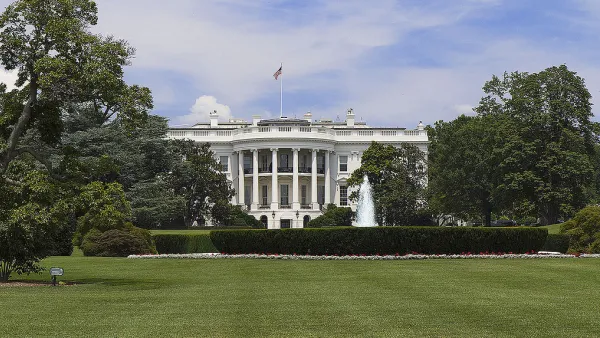
White House Shelves Reopening Guidelines Prepared by CDC
President Trump wants states to reopen businesses quickly but doesn't want to have the Centers for Disease Control and Prevention provide directions to business owners and transit agencies on how to open without spreading the coronavirus.
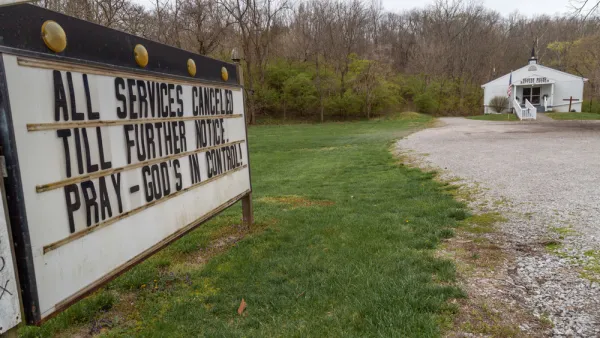
Religion in the Pandemic: First Amendment vs. Public Health and Safety
Conflicts between church and state are being decided in state and federal courts as governors act to protect their constituents from the coronavirus while religious institutions and their supporters seek exceptions from social gathering restrictions.
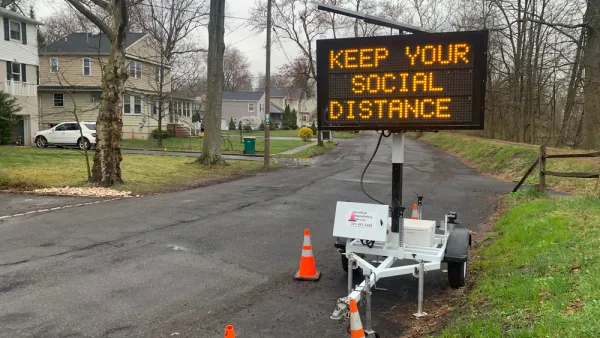
Report: Expect to Live with Two More Years of Social Distancing
As a majority of states relax stay-at-home restrictions, a prestigious team of experts from the University of Minnesota, Harvard and Tulane universities warns that the coronavirus will likely last 18 to 24 more months, returning in successive waves.

Planetizen Federal Action Tracker
A weekly monitor of how Trump’s orders and actions are impacting planners and planning in America.

The state-sanctioned urbicide of Austin
People don’t kill cities. Freeways do.

US to reduce Colorado River water deliveries to Mexico
A new Colorado Treaty amendment reduces Mexico’s Colorado River water allocation by 250,000 acre feet.

Mamdani overhauls NYC's Vision Zero plan with 100 new policy goals
The overhaul aims to reduce traffic deaths and make streets safer for pedestrians, cyclists and drivers through lower speed limits, new safety infrastructure and more.

Amtrak not solely to blame for New Jersey commuter rail's unreliability, report finds
A new study from the Garden State Initiative found that NJ Transit’s budget grew 20% across a 4 year period, but reliability declined significantly over the same period.

EPA erases limits on planet-warming pollution from power plants
Under Monday’s plan, power plants would still have some limits on how much mercury, arsenic and other contaminants they can emit.

FREE Course: Walkable City 1: Why Walkability?
After describing his path towards focusing on walkability as the essence of good planning, Jeff Speck marches through his five principal reasons for making more walkable places.
Reinventing Malls: Planning Alchemy—Turning Gray Fields Into Gold
The course focuses on the opportunities and imperatives that shape reinvention of mall sites.

Eagle County Government
Harvard University Graduate School of Design
Nashville Planning Department
The Architects Foundation
University of Cincinnati Online
The Pocatello Development Authority
The Urban Renewal Agency of the City of Pocatello
Journal of the American Planning Association