A deep dive into the statements on official housing policies of Joe Biden and Bernie Sanders in an era of intense housing anxieties.



Alissa Walker takes a dive into the housing platforms of the two remaining frontrunners for the Democratic nomination for president.
Now, with Biden neck-and-neck in the delegate count with Sen. Bernie Sanders, teasing out the nuances around rental assistance, neighborhood displacement, and how the government pays for housing may prove pivotal for Democratic voters in a country where a minimum-wage worker cannot afford to rent a two-bedroom apartment anywhere in the U.S. As voters pick between these two frontrunners, they’re choosing what the housing future of America might look like.
Former Vice President Biden for the first time addressed housing on the campaign trail just days before the recent primary in South Carolina, so some digging is required, but Walker calls on experts for insight, like Jenny Schuetz, an urban economist at the Brookings Institution; Rachel Reyes, an organizer for the Sanders campaign; and Diane Yentel, executive director of the National Low Income Housing Coalition. The latter of that group is on the record saying the campaign is pushing candidates to address housing in new ways—to the benefit of the country no matter who wins the nomination, and eventually, November's election.
Read the full story: In Biden vs. Sanders race, two differing visions for housing


How Did We Get Here? Housing Policy and Planners’ Role in Shaping Regional Growth and Prosperity
To navigate the complexities of the current U.S. housing crisis, planners and decision makers must first understand how decades of past policy decisions led us here.

'The Affordable City' Offers Solutions for the U.S. Housing Affordability Crisis
An excerpt from the new book by Shane Phillips, "The Affordable City," published by Island Press.
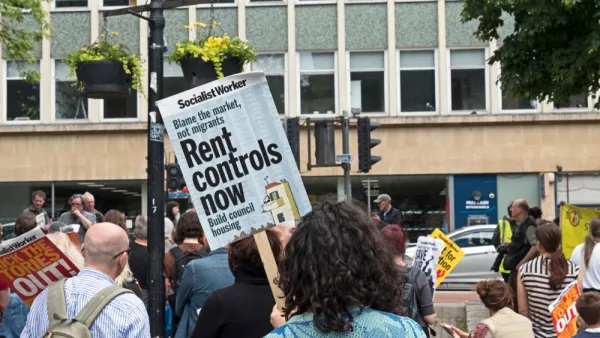
Another Rent Control Initiative on the Ballot in California
There are significant differences between Proposition 21, a statewide rent control measure on the ballot in California, compared to a similar measure defeated soundly by voters in 2018.

Planetizen Federal Action Tracker
A weekly monitor of how Trump’s orders and actions are impacting planners and planning in America.

California plans to bury El Niño’s downpour
If the state plays its cards right, it may be able to store a billion acre-feet of El Niño’s water in aquifers.

Chicago breaks ground on $3 billion megadevelopment
The new neighborhood, titled Foundry Park, will one day host 3,700 residences.

California High-Speed Rail Authority CEO resigns after $600,000 scandal
Under Ian Choudri, the authority used taxpayer dollars to fund first class flights and trips to nightclubs.

Want to study the Missouri River? Soon, you may need unanimous approval from 10 states
Legislation would require 10 governors’ permission to study or build projects moving water outside the basin.

Desperate measures: Advocates weigh draining Lake Powell to fill Colorado River
Draining the reservoir could reduce evaporation losses by a couple hundred thousand acre-feet.

FREE Course: Walkable City 1: Why Walkability?
After describing his path towards focusing on walkability as the essence of good planning, Jeff Speck marches through his five principal reasons for making more walkable places.
Reinventing Malls: Planning Alchemy—Turning Gray Fields Into Gold
The course focuses on the opportunities and imperatives that shape reinvention of mall sites.

City of Rosemead
Rutgers University, Edward J. Bloustein School of Planning and Public Policy
One Hundred Miles
Hunter College, City University of New York (CUNY)
The Architects Foundation
University of Cincinnati Online
City of Cambridge
Montrose County
The Pocatello Development Authority