A journalist asked, so Jarrett Walker answered.


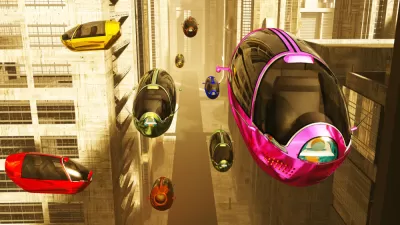
Jarrett Walker, of Human Transit fame, has seen the recent buzz surrounding flying cars, flying taxis, passenger drones, and Uber Air. A journalist that goes unnamed asked for Walker's opinion on the subject. Here's what Walker had to say:
For every technology pitch, you must ask not just “what is this like from the inside?” but also “what is it like from the outside?” All vehicle technologies are sold based on how cool or useful it will be to ride them. And most of these pitches do not want you think about what it will be like to be outside of them, or to share a city with them.
The issues with flying taxis, cars, passenger drones, and on-demand helicopter services are obvious, according to Walker:
Even if they are much quieter than helicopters, they will introduce a new type level of noise to the city, anywhere near where they takeoff and land. Their presence overhead in any numbers will have physical and emotional effects on the population. They will introduce entirely new kinds of accidents that make everyone fearful of the space above them. And in the end, by allowing elites to opt out of the transportation problems that everybody else in the city is having, they will encourage elite disinterest in solving those problems.
Walker isn't the first to communicate skepticism about the new wave of transportation futurism. Matt Caywood, CEO of TransitScreen, wrote an op-ed over the summer that said cities would be better off planning for and investing in public transit than fancy airborne solutions to the problems of urban congestion.
Read the full story: On Flying Cars

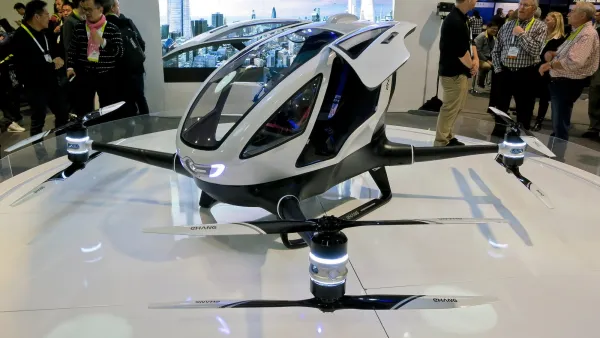
Flying Taxi Skepticism
A ride-hailing company that lost $5.2 billion in one quarter wants to launch a flying taxi service. According to this op-ed, cities should concentrate on expanding existing public transit systems instead of wasting time and money on pipe dreams.

Op-Ed: Designs for Uber's Skyports Fail on the Basics
The hulking structures proposed to handle UberAIR's fleet of flying taxis won't be able to serve 4,000 passengers per hour. And that's just one of their many deficiencies, Alissa Walker writes.
Are You Ready for a Sky Full of Autonomous Flying Taxis?
Some lucky people could be flying over traffic in autonomous drones within two years, according to a media blitz this morning.

Planetizen Federal Action Tracker
A weekly monitor of how Trump’s orders and actions are impacting planners and planning in America.

California plans to bury El Niño’s downpour
If the state plays its cards right, it may be able to store a billion acre-feet of El Niño’s water in aquifers.

Desperate measures: Advocates weigh draining Lake Powell to fill Colorado River
Draining the reservoir could reduce evaporation losses by a couple hundred thousand acre-feet.

California city breaks ground on transit connector
The project includes three mobility hubs and a pedestrian bridge.

After public outcry, Massachusetts city releases housing development tracker
Cambridge’s tracker currently shows 250 housing projects in various stages of development.

40 years after approval, Chicago breaks ground on new park
The park honors Jean Baptiste Point du Sable, the city’s first permanent non-native settler.

FREE Course: Walkable City 1: Why Walkability?
After describing his path towards focusing on walkability as the essence of good planning, Jeff Speck marches through his five principal reasons for making more walkable places.
Reinventing Malls: Planning Alchemy—Turning Gray Fields Into Gold
The course focuses on the opportunities and imperatives that shape reinvention of mall sites.

City of Rosemead
Rutgers University, Edward J. Bloustein School of Planning and Public Policy
One Hundred Miles
Hunter College, City University of New York (CUNY)
The Architects Foundation
University of Cincinnati Online
City of Cambridge
Montrose County
The Pocatello Development Authority