Local governments are fighting control after federal regulators removed some of the regulatory protections that could slow private companies from grabbing land in an effort



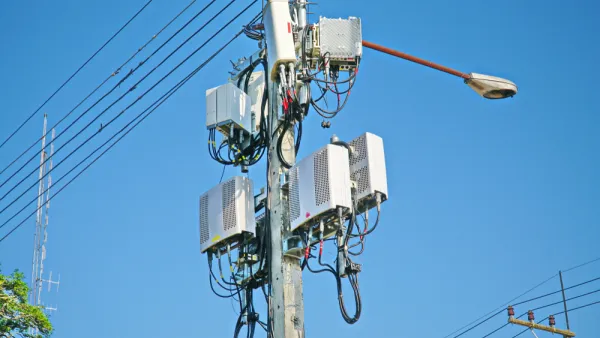
"Anxiety around the deployment [of 5G wireless Internet technology] has only been heightened in the wake of a Federal Communications Commission (FCC) decision handed down last year to accelerate approval times and cap fees that cities could charge for installing small cells, the infrastructure needed for 5G," reports Chris Teale.
"While some have turned to litigation to try and overturn the ruling — a bill pending in Congress would do the same — some experts suggest cities prepare a strong roll out plan for 5G."
Teale is sharing insights into just what form such local plans could take, shared by participants at the recent Smart Cities Connect conference in National Harbor, Maryland.
Previous coverage from Planetizen provides background on the ongoing debate between local governments and the federal government on the rollout of 5G technology.
- Feds Streamline Approvals for 5G Infrastructure (March 2018)
- Cities Sue Feds Over 5G Rules (October 2018)
- 2019 Already a Big Year For 'Smart City' Evolution (April 2019)
- 4 Regulatory Complications of 5G Infrastructure Development (May 2019)
- U.S. Falling Behind in Smart City Deployments and Key 21st Century Infrastructure (July 2019)
Read the full story: Cities are facing 'an absolute land grab' from telecoms in wake of 5G
Feds Streamline Approvals for 5G Infrastructure
Most deployment of 5G "small cells" won't get any resistance from federal regulations.
Cities Sue Feds Over 5G Rules
Cities want more control over the deployment of 5G technology. The federal government has been working to limit local regulatory powers over new wireless technology.
$9 Billion for Rural 5G
The Federal Communications Commission announced a new 5G Fund this week.

Desperate measures: Advocates weigh draining Lake Powell to fill Colorado River
Draining the reservoir could reduce evaporation losses by a couple hundred thousand acre-feet.

Eastern Nebraska is running out of electricity
Data centers and electrification are straining eastern Nebraska’s grid, throttling economic development.

Malls are becoming the midtowns of the future
Mall and office park redevelopments are a generational opportunity to create new nodes of urbanity.

NYC breaks ground on anti-flooding infrastructure project
New York City's new system will reduce stormwater flows to local sewers by 90%.

One Kentucky town’s secret to affordable housing
The Smoketown Community Land Trust has already built seven affordable homes for community members.

Houston gains petal-shaped cooling infrastructure to make streets more ‘delightful’
The city has installed the pavilions along 15 blocks in Houston.

FREE Course: Walkable City 1: Why Walkability?
After describing his path towards focusing on walkability as the essence of good planning, Jeff Speck marches through his five principal reasons for making more walkable places.
Reinventing Malls: Planning Alchemy—Turning Gray Fields Into Gold
The course focuses on the opportunities and imperatives that shape reinvention of mall sites.

City of Rosemead
Rutgers University, Edward J. Bloustein School of Planning and Public Policy
One Hundred Miles
University of Michigan School for Environment and Sustainability (SEAS)
Hunter College, City University of New York (CUNY)
The Architects Foundation
City of Cambridge
Montrose County
The Pocatello Development Authority