Transportation planning will take on a much more safety-oriented focus according to the West Side Vision Zero Traffic Safety Plan announced last week.


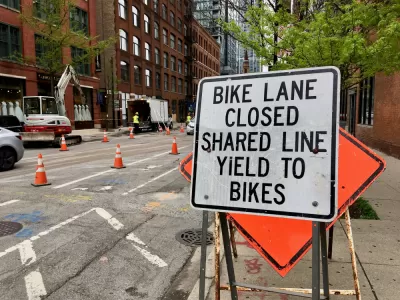
The city of Chicago has a new West Side Vision Zero Traffic Safety Plan, reports John Greenfield, who calls the new plan a milestone for the city's crash prevention policies.
Here's how Greenfield describes the plan's substance:
The Vision Zero West Side Plan includes 15 strategies to improve traffic and pedestrian safety in East and West Garfield Park, North Lawndale and Austin. The recommendations include safety improvements around transit stations; efforts to promote walking and biking to school and make it safer; the installation of pedestrian islands and other walking infrastructure and curb extensions in other locations in the communities, and a street remix for the pedestrian-hostile “Five Corners” intersection of Ogden, Pulaski and Cermak.
The article includes a lot of statements from officials to summarize the goals and expected results of the new plan, as well as a discussion by Greenfield of where the new plan fits into the context of the city's larger Vision Zero efforts since the city released its initial Vision Zero Chicago Action Plan in 2017.
Read the full story: Chicago unveils its West Side Vision Zero Traffic Safety Plan

‘We Will Chicago’ Plan Adopted in the Windy City
Chicago has its first “comprehensive plan” since the 1960s, but without a land use map, the “We Will Chicago” plan is devoted more to laying out the issues and challenges facing the city than setting new policies.
Nascar Set to Race the Streets of Chicago Starting in 2023
Nascar races are a series of loops. Chicago has The Loop. Chicago also has a heated debate about traffic safety that probably doesn't have room for sponsored cars doing speeds upward of 100.
Planning for Congestion Relief
The third and final installment of Planetizen's examination of the role of the planning profession in both perpetuating and solving traffic congestion.

Planetizen Federal Action Tracker
A weekly monitor of how Trump’s orders and actions are impacting planners and planning in America.

Amtrak, CN end decades-long dispute with eight-year agreement
The new operating agreement establishes an updated framework for the companies to work together, including processes to resolve disputes.

Judges permit Denver to divert 77,000 acre feet from the Colorado River for reservoir expansion
Overuse and climate change have caused the Colorado River’s water levels to plummet.

NYC DOT wants faster, more permanent street upgrades
The city is examining ways to build more concrete infrastructure without getting entangled in 'decades-long' projects.

'Something we’ve never seen before:' rising utility rates could strain city finances nationwide
Data centers, climate change and other factors have caused utility rates in the United States to increase by 38% since 2020.

Trump to overrule local leaders, lease millions of acres of America’s Pacific Island territories’ seafloors to mining companies
International law says that the Indigenous people of America’s territories have a right to prior and informed consent regarding projects that impact their countries.

FREE Course: Walkable City 1: Why Walkability?
After describing his path towards focusing on walkability as the essence of good planning, Jeff Speck marches through his five principal reasons for making more walkable places.
Reinventing Malls: Planning Alchemy—Turning Gray Fields Into Gold
The course focuses on the opportunities and imperatives that shape reinvention of mall sites.

Harvard University Graduate School of Design
KFH Group Inc.
Greater Baltimore Committee
The Architects Foundation
University of Cincinnati Online
The Pocatello Development Authority
The Urban Renewal Agency of the City of Pocatello