Google Maps is built for able-bodied people, but the AccessMap Seattle app is for everyone.


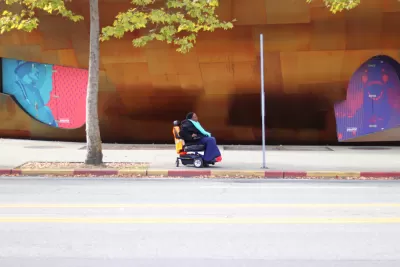
Megan Wildhood shares news of a website and mobile app called AccessMap Seattle, where "users can find streets color-coded for steepness (green for flat, yellow for moderate, and red for steep), and the locations of curb cuts, bus stops, and elevators, as well as construction sites, which tend to sprawl and block crosswalks and sidewalks."
Nick Bolten, developer of AccessMap Seattle, is now partnering with Anat Caspi, director of The Taskar Center for Accessible Technology at the University of Washington, to further develop the app, especially in identifying different mobility challenges facing people with special needs. And there plenty of complications in the world:
The diversity of disability also complicates data collection: A map of sidewalks, curb cuts, or steepness of streets might not be sufficient for those with limited mobility. For example, are there major cracks in the sidewalk because of disrepair, tree roots, or other damage? Does the sidewalk slope at an angle dangerous to wheelchair users? To source such varying data, the AccessMap team is considering GPS navigation app Waze as a model.
The app is still in development, but some users are already testing the app. "Eventually, the team hopes, it could benefit those with mobility limitations who navigate Seattle, especially those without knowledge of the city’s lesser-known accessible routes. And it could also benefit the larger public by producing data to drive forward discussions of access and ability," writes Wildhood.
Read the full story: How Steep Is That Sidewalk? A Digital Map for People With Disabilities
'Project Sidewalk' Crowdsources ADA Compliance
A crowdsourcing app allows citizens to hold the public realm to higher standards of access and mobility.

Commentary: LA’s ‘Large Asphalt Repair’ Policy Privileges Drivers, Endangers Others
A new policy to perform spot repairs rather than resurfacing entire streets lets the city skirt requirements to install accessibility and pedestrian infrastructure.
Chicago Residents Sue City Over Inaccessible Sidewalks
The suit alleges the city has failed to create a “coordinated, proactive system” for complying with ADA and ensuring accessibility on the city’s sidewalks and crosswalks.

Planetizen Federal Action Tracker
A weekly monitor of how Trump’s orders and actions are impacting planners and planning in America.

California plans to bury El Niño’s downpour
If the state plays its cards right, it may be able to store a billion acre-feet of El Niño’s water in aquifers.

Desperate measures: Advocates weigh draining Lake Powell to fill Colorado River
Draining the reservoir could reduce evaporation losses by a couple hundred thousand acre-feet.

Chicago voters approve permanent festival grounds, penalty for vacant property owners
Currently, major summer and fall festivals take over public parks for weeks at a time, drawing criticism from nearby residents

NYC votes to cut outdoor dining red tape, speed up permitting
New York City also voted to allow the Department of Transportation to begin work on urgent projects before notifying elected officials.

California appears to reject Prop. 45
The proposition would have expanded the projects that qualify for a streamlined environmental review, effectively paring down the California Environmental Quality Act.

FREE Course: Walkable City 1: Why Walkability?
After describing his path towards focusing on walkability as the essence of good planning, Jeff Speck marches through his five principal reasons for making more walkable places.
Reinventing Malls: Planning Alchemy—Turning Gray Fields Into Gold
The course focuses on the opportunities and imperatives that shape reinvention of mall sites.

City of Rosemead
Rutgers University, Edward J. Bloustein School of Planning and Public Policy
One Hundred Miles
Hunter College, City University of New York (CUNY)
The Architects Foundation
University of Cincinnati Online
City of Cambridge
Montrose County
The Pocatello Development Authority