Across the country, community solar is taking off and making the financial and environmental benefits of solar energy more accessible.


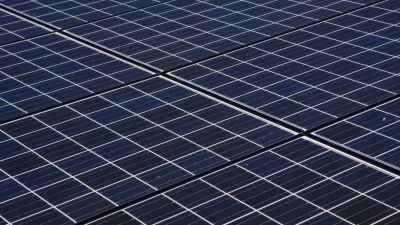
Patrick Sisson reports that New York City is seeing a crop of new community solar projects providing cheaper energy to more people. He describes how the Altus Bronx Community Solar Farm works:
Power generation is centralized on the rooftop of this self-storage company, which gets paid for hosting the panels. But 150 New Yorkers who subscribe to the program benefit from the power generated here—all without upfront costs or equipment installation—and see a 5 to 10 percent discount on their electricity bills.
Residents, particularly renters, and small business owners can take advantage of lower energy costs, and the programs offer building owners an additional income stream. Cities, notes Sisson, are good locations for community solar because they have lots of rooftops and many potential customers.
State legislation in 2015 brought community solar to New York, but recent state regulatory changes have made the process much less onerous. The projects are more feasible now that larger installations are allowed, small businesses can become subscribers, and developers have more incentives to put in solar infrastructure.
"In addition, combined with the state’s push to develop energy storage capacity, new community solar can provide an economic benefit by leveraging private capital, creating jobs, and lowering rates, according to David Sandbank, Director of Distributed Energy Resources at [the New York State Energy Research and Development Authority], all while creating a smarter, more resilient grid," writes Sisson.
Read the full story: Community solar may be the solution to help New York go green

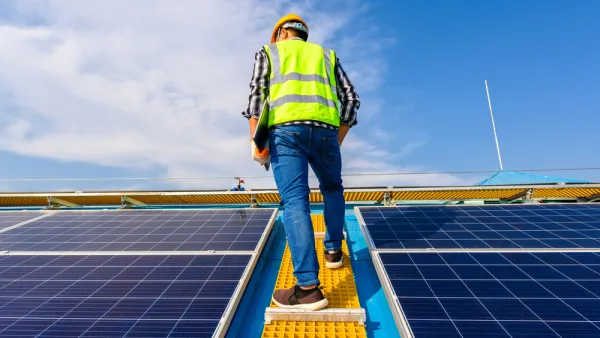
Rooftop Solar Hampered by New York City Fire Code
Requirements in the NYFD fire code make it costly and difficult to achieve the city’s solar installation goals.
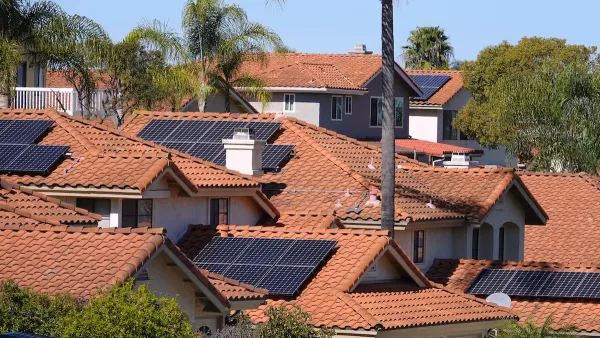
California Leads in Solar Rooftops
A combination of state and local incentives and building code mandates has helped California far outpace other states in residential rooftop solar permits.
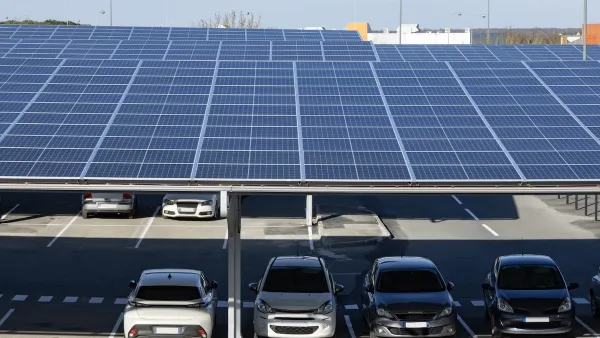
Commercial Buildings, Parking Lots Offer Significant Potential for Solar Energy
Massive swaths of flat rooftops, garages, and surface parking lots go underutilized. They could be producing renewable energy.

Planetizen Federal Action Tracker
A weekly monitor of how Trump’s orders and actions are impacting planners and planning in America.
Colorado’s Largest Data Center Could Rise Next to Homes — Without a Public Hearing
The proposed campus would consume 11 times the power of Denver International Airport; as it has across the country, opposition mounts.

US to reduce Colorado River water deliveries to Mexico
A new Colorado Treaty amendment reduces Mexico’s Colorado River water allocation by 250,000 acre feet.

'This is going to be painful:’ Virginia stares down $1.7 billion funding gap for highway maintenance
The state may address the deficit by shifting $290 million from its construction budget to maintenance projects.

Judges permit Denver to divert 77,000 acre feet from the Colorado River for reservoir expansion
Overuse and climate change have caused the Colorado River’s water levels to plummet.

Amtrak, CN end decades-long dispute with eight-year agreement
The new operating agreement establishes an updated framework for the companies to work together, including processes to resolve disputes.

FREE Course: Walkable City 1: Why Walkability?
After describing his path towards focusing on walkability as the essence of good planning, Jeff Speck marches through his five principal reasons for making more walkable places.
Reinventing Malls: Planning Alchemy—Turning Gray Fields Into Gold
The course focuses on the opportunities and imperatives that shape reinvention of mall sites.

KFH Group Inc.
Greater Baltimore Committee
Eagle County Government
The Architects Foundation
University of Cincinnati Online
The Pocatello Development Authority
The Urban Renewal Agency of the City of Pocatello