Established in 2005 to reduce toxic diesel emissions, the Diesel Emissions Reductions Act expired in 2016. A bipartisan effort appears to be in place to see it reauthorized this year.


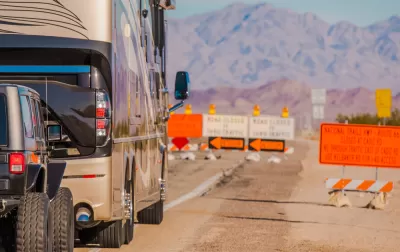
"Sen. Tom Carper led his colleagues in introducing bipartisan legislation [S.747] that would reauthorize the Diesel Emissions Reduction Act through fiscal 2024," reports Eugene Mulero for Transport Topics.
The program, administered by the U.S. Environmental Protection Agency, relies on federal grants and rebates. The funding is used to help finance the voluntary replacement or installation of retrofits on existing heavy-duty diesel vehicles and engines.
The program is so successful, every dollar invested in DERA generates a 13-fold return in health and economic benefits,” said Carper (D-Del.), ranking member on the Environment and Public Works Committee.
"U.S. Senator John Barrasso (R-Wyo.), chairman of the Senate Committee on Environment and Public Works (EPW), highlighted the importance of the Diesel Emissions Reduction Act (DERA) to communities in Wyoming," according to his March 13 press release. [Bill number not available as of March 18].
Barrasso noted several school districts in Wyoming have used funds from the DERA program to replace aging school buses, both to improve efficiency and reduce emissions.
“This funding has been key to incentivizing and expanding port environmental programs to improve air quality impacted by port operations,” American Association of Port Authorities stated during an EPW hearing March 13. Other DERA proponents include American Trucking Associations for reasons acknowledged by Sen. James Inhofe (R-Okla.) a day earlier:
"The program has been used to voluntarily upgrade more than 73,000 diesel-powered vehicles, all while creating lucrative manufacturing jobs. I am proud to have supported the program since it was first created more than a decade ago and I am proud to once again introduce bipartisan legislation to reauthorize such an effective program with Sens. Carper, Barrasso and Whitehouse.”
"On March 14, House lawmakers followed their EPW Senate counterparts to unveil a version of the DERA reauthorization," adds Mulero. "The House bill also would enable upgrades to diesel engines."
Bipartisan support does that mean the bill will succeed. Mulero noted that notwithstanding the chairman's apparent support for the program, at the March 13 hearing he "would not specify when the panel would take up the bill during the 116th Congress."
However, a DERA reauthorization bill did pass the Senate last year, but the House bill was never heard. With Democrats in control of that branch of Congress, perhaps it will fare better this year, although the bill is yet to be numbered as of March 18 and doesn't show on the House Committee on Energy and Commerce website.
Successful bipartisan legislation passed by the Senate Committee on Environment and Public Works:
The committee's webpage notes these three bills that became laws:
- President Trump Signs Bipartisan Wildlife Conservation Legislation into Law, March 12, 2019. The WILD Act was included in S. 47, the Natural Resources Management Act, posted here.
- President Trump Signs Bipartisan Nuclear Energy Legislation into Law, January 14, 2019 [S. 512]
- President Trump Signs America’s Water Infrastructure Act into Law, October 23, 2018 [S. 3021]
Read the full story: Senators Introduce Diesel Emissions Bill


Trump's State of the Union: More on Infrastructure in Democrats' Response
The president spoke briefly about infrastructure in his third State of the Union address last Tuesday, urging Congress to pass the bipartisan America’s Transportation Infrastructure Act of 2019. Michigan Gov. Gretchen Whitmer had a lot more to say.
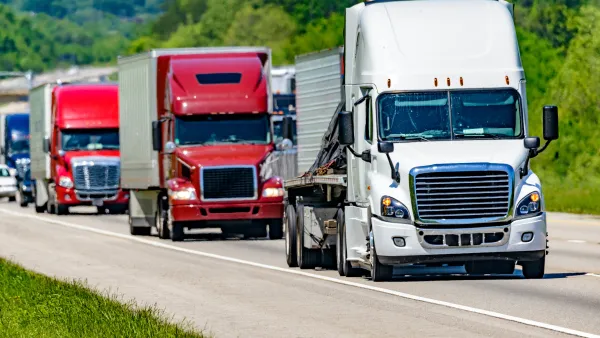
Biden's Truck Pollution Rule Hanging by a Thread
Four House Democrats joined all but one Republican to enact the Congressional Review Act to roll back President Biden's rule on heavy truck pollution approved by the EPA last December. The Senate had earlier narrowly passed the joint resolution.

Historic Climate Legislation Included in COVID Relief Spending Deal
The $900 billion COVID relief bill along with a $1.4 trillion omnibus bill allowed for the inclusion of unrelated legislation and funding for 2021, from border wall spending to phasing-out some of the most potent greenhouse gas pollutants.

Planetizen Federal Action Tracker
A weekly monitor of how Trump’s orders and actions are impacting planners and planning in America.

California plans to bury El Niño’s downpour
If the state plays its cards right, it may be able to store a billion acre-feet of El Niño’s water in aquifers.

Chicago breaks ground on $3 billion megadevelopment
The new neighborhood, titled Foundry Park, will one day host 3,700 residences.

California High-Speed Rail Authority CEO resigns after $600,000 scandal
Under Ian Choudri, the authority used taxpayer dollars to fund first class flights and trips to nightclubs.

Want to study the Missouri River? Soon, you may need unanimous approval from 10 states
Legislation would require 10 governors’ permission to study or build projects moving water outside the basin.

Desperate measures: Advocates weigh draining Lake Powell to fill Colorado River
Draining the reservoir could reduce evaporation losses by a couple hundred thousand acre-feet.

FREE Course: Walkable City 1: Why Walkability?
After describing his path towards focusing on walkability as the essence of good planning, Jeff Speck marches through his five principal reasons for making more walkable places.
Reinventing Malls: Planning Alchemy—Turning Gray Fields Into Gold
The course focuses on the opportunities and imperatives that shape reinvention of mall sites.

City of Rosemead
Rutgers University, Edward J. Bloustein School of Planning and Public Policy
One Hundred Miles
Hunter College, City University of New York (CUNY)
The Architects Foundation
University of Cincinnati Online
City of Cambridge
Montrose County
The Pocatello Development Authority