Activists threaten to sue after the city of Los Angeles decided to forgo environmental review on a street reconfiguration project that removed a vehicle lane on Venice Boulevard.


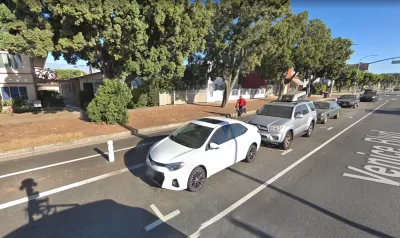
"Setting the stage for a legal challenge, the Los Angeles City Council rejected an appeal Friday from neighborhood advocates fighting a bicycle lane on a congested Westside artery," reports Laura J. Nelson.
The controversy surrounds a 0.8-mile stretch of Venice Boulevard in the neighborhood of Mar Vista.
"The city spent $1.8 million to add four traffic signals, sidewalk mosaics, curb ramps, more visible crosswalks and a bike lane with a buffer zone to separate drivers from cyclists," according to Nelson. "The project removed one vehicle travel lane in each direction."
The bike lane enjoys some public support, but opponents have been threatening to sue the city if the City Council made the pilot project permanent. After the City Council voted in December to make the project permanent, opposition groups appealed, which set the stage for last week's decision.
As noted by Nelson, the city's Vision Zero goals and its Mobility 2035 plan, have encountered resistance wherever road lanes for cars have been removed—perhaps most infamously in 2017, when the city reversed nine miles of road diets in Mar Vista and nearby Playa del Rey.
FULL STORY: L.A. backs Venice Boulevard’s controversial ‘road diet’ as activists threaten to sue

Los Angeles Can't Stick to its Road Diet
A high-profile controversy over a decision by the city of Los Angeles to remove a vehicle lane in either direction has finally come to an end. The vehicle lanes will be restored.
When it Comes to Road Diets, Evidence Doesn't Matter
Drivers are a powerful enough lobby to overcome all evidence of the need to redesign streets for safety. Examples from Maryland and Virginia provide the latest case studies in Vision Zero futility.
Changes Approved for Pedestrian Safety on San Francisco's Sixth Street
A safety-minded street reconfiguration overcame opposition in San Francisco thanks to strong political leadership.

Planetizen Federal Action Tracker
A weekly monitor of how Trump’s orders and actions are impacting planners and planning in America.

The state-sanctioned urbicide of Austin
People don’t kill cities. Freeways do.

US to reduce Colorado River water deliveries to Mexico
A new Colorado Treaty amendment reduces Mexico’s Colorado River water allocation by 250,000 acre feet.

5 New England states march closer to 800 megawatt wind energy project
Securing federal approval for the project may be complicated under the Trump administration, which has historically been hostile towards domestic wind power.

Baltimore to break ground on $50 million Transit Priority Project
The project will bring faster bus trips, safer streets and better bike connections to Baltimore.

Airbnb launches $250 million 'last-dollar financing' housing accelerator, makes first investment in Austin
The company will put $6.4 million towards affordable housing development in Texas’ capital.

FREE Course: Walkable City 1: Why Walkability?
After describing his path towards focusing on walkability as the essence of good planning, Jeff Speck marches through his five principal reasons for making more walkable places.
Reinventing Malls: Planning Alchemy—Turning Gray Fields Into Gold
The course focuses on the opportunities and imperatives that shape reinvention of mall sites.

Eagle County Government
Harvard University Graduate School of Design
Nashville Planning Department
The Architects Foundation
University of Cincinnati Online
The Pocatello Development Authority
The Urban Renewal Agency of the City of Pocatello
Journal of the American Planning Association