Austin seems like a safe bet to be one fo the next cities to end parking minimums citywide, and advocates are already pressing for the change.


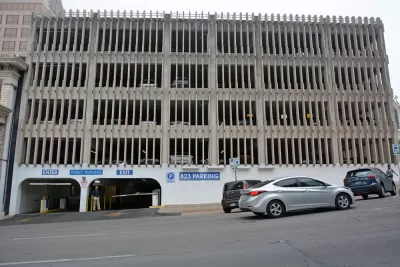
The Austin Pedestrian Advisory Council is recommending that the City Council eliminate parking minimums from the city's land use code entirely.
"The Pedestrian Advisory Council is asking City Council to confront a broad spectrum of issues this year with a simple change to the city’s dated land use code," reports Ryan Thornton.
Earlier this month, "PAC approved a recommendation to Council to eliminate mandated parking minimums from the city’s land use code entirely. Among other requests, the recommendation includes managing parking supply with dynamic pricing adjustments, citywide expansion of the current Parking Benefit District structure and disincentivizing construction of aboveground parking garages in new developments," according to Thornton.
Thornton headlines this news by teasing the possibility that 2019 could be the year that Austin ends parking minimums citywide. A 2013 law ended parking minimums for the central business district, and locals report little impact on development in the area.
Read the full story: 2019 could be the year to end city parking minimums


Austin Debates Parking Reforms Near TOD Projects
City officials are deciding how to change parking requirements for transit-oriented developments that are meant to discourage private car ownership.

Berkeley to Remove Parking Requirements for Residential Properties
Berkeley is the second city in Northern California to approve landmark zoning reforms so far in 2021.
Statewide Zoning Changes Adopted in Oregon to Limit Parking, Add Missing Middle
The state of Oregon made planning history in 2019 by adopting House Bill 2001, paving the way for the state to preempt local exclusionary zoning laws. Now, over a year later, the state land use board has decided how to implement that goal.

Planetizen Federal Action Tracker
A weekly monitor of how Trump’s orders and actions are impacting planners and planning in America.

California plans to bury El Niño’s downpour
If the state plays its cards right, it may be able to store a billion acre-feet of El Niño’s water in aquifers.

Desperate measures: Advocates weigh draining Lake Powell to fill Colorado River
Draining the reservoir could reduce evaporation losses by a couple hundred thousand acre-feet.

California city breaks ground on transit connector
The project includes three mobility hubs and a pedestrian bridge.

After public outcry, Massachusetts city releases housing development tracker
Cambridge’s tracker currently shows 250 housing projects in various stages of development.

40 years after approval, Chicago breaks ground on new park
The park honors Jean Baptiste Point du Sable, the city’s first permanent non-native settler.

FREE Course: Walkable City 1: Why Walkability?
After describing his path towards focusing on walkability as the essence of good planning, Jeff Speck marches through his five principal reasons for making more walkable places.
Reinventing Malls: Planning Alchemy—Turning Gray Fields Into Gold
The course focuses on the opportunities and imperatives that shape reinvention of mall sites.

City of Rosemead
Rutgers University, Edward J. Bloustein School of Planning and Public Policy
One Hundred Miles
Hunter College, City University of New York (CUNY)
The Architects Foundation
University of Cincinnati Online
City of Cambridge
Montrose County
The Pocatello Development Authority