A big idea is gaining momentum.



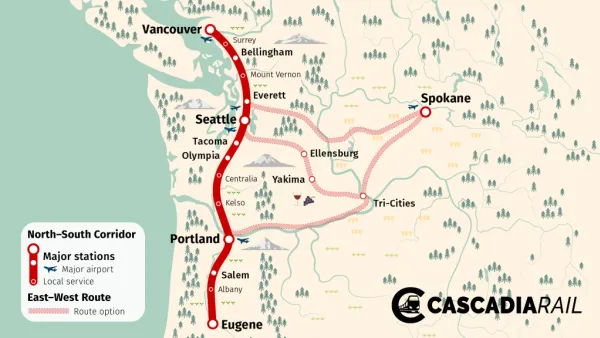
Democrats in the Washington State Legislature introduced a bill that would interstate high-speed rail authority with Oregon and British Columbia. "The move takes Seattle a step closer to one-hour train trips to Portland and Vancouver, British Columbia," reports Stephen Fesler.
The bill would give the new high-speed rail authority the power to operate "harmoniously across two states, a province, and an international boundary."
"The authority would also engage with communities along the corridor to refine the alignment and make recommendations on funding levels and responsibilities to carry out advanced project development," according to Fesler.
The bill also would allow "$3.25 million in guaranteed funding from the state multimodal transportation account for the interstate high-speed rail authority."
If approved, the legislation would add to a string of accomplishments moving the idea toward reality. "High-speed rail advocates landed a big victory last year when the state legislature committed $1.2 million–of which was $750,000 in direct state grants–to a business case study for high-speed rail from Vancouver, British Columbia to Portland," according to Fesler.
FULL STORY: Cascadia Interstate High-Speed Rail Authority Chugging Toward Legislative Approval

Cascadia High-Speed Rail Corridor Seeking Federal Funding
The state of Washington is hoping federal infrastructure funding can pay for $198 million of the $348 million necessary to plan the Cascadia High-Speed Rail project.

Cascadia High Speed Rail Authority Has its First Funding
The state of Washington has allocated funding from its 2019-2021 biennium transportation appropriations bill to study the creation of the Cascadia High Speed Rail Authority.
Cross-Border High-Speed Rail Studied for the Pacific Northwest
The state of Washington has taken a first, serious look at a high-speed rail project linking Vancouver in British Columbia to Seattle and Portland.

Planetizen Federal Action Tracker
A weekly monitor of how Trump’s orders and actions are impacting planners and planning in America.

The state-sanctioned urbicide of Austin
People don’t kill cities. Freeways do.

US to reduce Colorado River water deliveries to Mexico
A new Colorado Treaty amendment reduces Mexico’s Colorado River water allocation by 250,000 acre feet.

5 New England states march closer to 800 megawatt wind energy project
Securing federal approval for the project may be complicated under the Trump administration, which has historically been hostile towards domestic wind power.

Baltimore to break ground on $50 million Transit Priority Project
The project will bring faster bus trips, safer streets and better bike connections to Baltimore.

Airbnb launches $250 million 'last-dollar financing' housing accelerator, makes first investment in Austin
The company will put $6.4 million towards affordable housing development in Texas’ capital.

FREE Course: Walkable City 1: Why Walkability?
After describing his path towards focusing on walkability as the essence of good planning, Jeff Speck marches through his five principal reasons for making more walkable places.
Reinventing Malls: Planning Alchemy—Turning Gray Fields Into Gold
The course focuses on the opportunities and imperatives that shape reinvention of mall sites.

Eagle County Government
Harvard University Graduate School of Design
Nashville Planning Department
The Architects Foundation
University of Cincinnati Online
The Pocatello Development Authority
The Urban Renewal Agency of the City of Pocatello
Journal of the American Planning Association