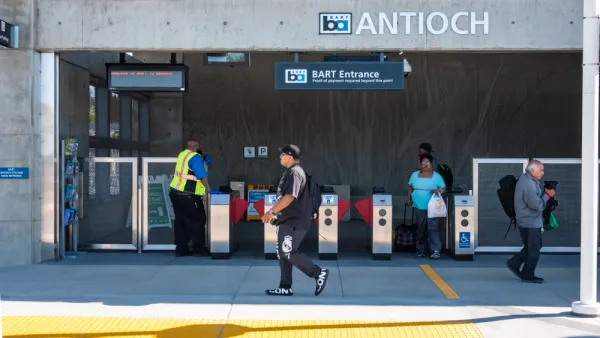
In an opinion piece bemoaning the passage of legislation that gives the BART board new land use planning authority, BART Director Deborah Allen argues that planners won't make good directors because they lack independence.



After California's controversial Senate Bill 827 died last April, another bill that dealt with the preemption of local land use authority received more attention, particularly from the East Bay cities where it would apply.
The ink of Gov. Jerry Brown's signature on Assembly Bill 2923: San Francisco Bay Area Rapid Transit District: transit-oriented development had barely dried before Bay Area leaders expressed concerns about giving zoning authority to the BART board, even if only applied to its own parking lots.
One of the more interesting opinions was from BART Board of Directors member Debora Allen, whose district covers stations in the Contra Costa County cities of Concord, Lafayette, Pleasant Hill, and Walnut Creek.
The "legislation giving BART directors zoning authority on the vacant land and parking lots surrounding suburban stations represents a public policy setback for California," writes Allen on Oct. 10 for the East Bay Times. "Cities no longer have authority over things like building height, density, parking replacement and low-income housing ratios."
Readers may find it surprising that the bill, authored by Assemblymembers David Chiu (D-San Francisco) and Timothy S. Grayson (D-Concord) to address the region's housing shortage, was not sponsored by the nine-member elected BART Board of Directors.
In a Sept. 30 statement on BART's new land use authority, BART General Manager Grace Crunican writes that "the BART Board of Directors took an official 'neutral' stance" on the bill, adding:
BART's aim is to partner with the community to build 20,000 new housing units at its stations by the year 2040, and to ensure that at least 35% are affordable.
In her column, Allen singles out professionals in land use planning and related fields, casting a rather wide net, that BART directors need be wary of.
BART directors now and in the future must be capable of making decisions that consider the specific economic needs of each community, without the undue influence of urban planners, land-use consultants, developers, builders, architects, engineers and unions.
It's not just BART directors, though, that should be concerned about the influence of professionals with land use planning expertise, adds Allen. Voters should be as well.
Given the new control handed the regionally elected nine-member BART board, it is more important than ever that we elect directors who can demonstrate their independence from special interests.
Those who already feared the flow of special interest money into BART elections now have cause for greater concern as outside interests try to influence directors suddenly given new power. This November, there are four career urban planners or land-use consultants running for BART director, one in each of the four districts on the ballot.
There is some irony to Allen's singling out of planners when the profession, as represented by the California Chapter of the American Planning Association, actually opposed the bill.
Much like Sen. Scott Wiener's SB 827 (which apparently will be reintroduced next year), AB 2923 has elicited strong reactions from policymakers and others concerned about urban issues. On the opposite side of the spectrum, Steven Falk, city manager of Lafayette for the last 22 years, cited the city council's opposition to the bill as having factored into his retirement announced last month.
Hat tip to Bill Murray for his perceptive comment.
FULL STORY: Opinion: New BART housing law makes elections much more critical

BART TOD Bill Advances Despite Opposition from East Bay Cities
Amidst fierce opposition from East Bay cities who want to control the destiny of BART parking lots in their jurisdictions, Assembly Bill 2923, which would partially preempt local land use authority, passed a critical committee last Thursday.

BART's Transit-Oriented Development Bill Sets Disturbing Precedent, Says APA
AB 2923, which would allow the Bay Area Rapid Transit District to rezone their properties near stations for transit-oriented development, passed its first committee. The California chapter of APA objects to the preemption of local land use authority.

Editorial Exposes Bay Area Housing Hypocrisy
Cities can't have it both ways on the housing crisis, asserts an SF Chronicle editorial. Case in point: Berkeley passes a resolution to declare homelessness a state of emergency while opposing legislation to allow BART to develop its parking lots.

The state-sanctioned urbicide of Austin
People don’t kill cities. Freeways do.

US to reduce Colorado River water deliveries to Mexico
A new Colorado Treaty amendment reduces Mexico’s Colorado River water allocation by 250,000 acre feet.

New Jersey’s second-largest city bans standalone data centers
Jersey City will continue to allow co-location facilities, such as those meant for research institutions that store their own data.

Amtrak not solely to blame for New Jersey commuter rail's unreliability, report finds
A new study from the Garden State Initiative found that NJ Transit’s budget grew 20% across a 4 year period, but reliability declined significantly over the same period.

EPA erases limits on planet-warming pollution from power plants
Under Monday’s plan, power plants would still have some limits on how much mercury, arsenic and other contaminants they can emit.

Phoenix announces new on-demand transit service, more frequent RAPID buses
Both new services will launch in October, and are part of Phoenix's Project Effective Access Solutions for Easing Congestion.

FREE Course: Walkable City 1: Why Walkability?
After describing his path towards focusing on walkability as the essence of good planning, Jeff Speck marches through his five principal reasons for making more walkable places.
Reinventing Malls: Planning Alchemy—Turning Gray Fields Into Gold
The course focuses on the opportunities and imperatives that shape reinvention of mall sites.

Eagle County Government
Harvard University Graduate School of Design
Nashville Planning Department
The Architects Foundation
University of Cincinnati Online
The Pocatello Development Authority
The Urban Renewal Agency of the City of Pocatello
Journal of the American Planning Association