As more companies start to run private buses, some of which use public transit bus stops, the question of whether or not they're getting in the way has become more hotly contested.


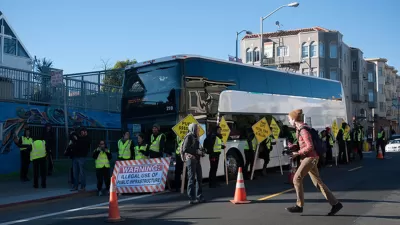
Seattle commuters headed to businesses around the city often wait at public bus stops, even if they aren't waiting for public transit. Seattle Children's Hospital and Microsoft both run private shuttles. A new study from University of Washington suggests travel times on public transit are unaffected by these shuttles.
"To determine if the shuttles negatively impacted public buses’ reliability, MacKenzie and civil and environmental engineering doctoral student, Elyse Lewis, partnered with Swiftly, a company that acquires and cleans up real-time performance data from trackers on public transit," Sarah McQuate reports for UW News. The researchers pulled data on the transit times of a bus route in the six weeks before and after the route was joined by a private shuttle. After monitoring bus times at more than 70 stops for 12 weeks, the researchers found little change in the performance of public buses.
Read the full story: Bus battle: Do private shuttles affect the reliability of public transit?
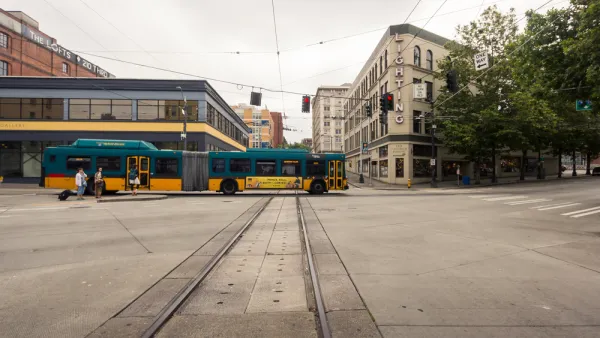
A ‘Playbook’ for Better Bus Service, From King County Metro
King County Metro operates one of the nation’s busiest transit systems—without running any trains. The agency recently released a playbook as a guide to transit service.
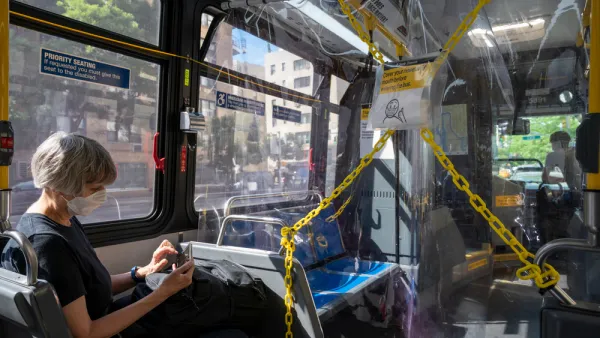
Backtracking From Ambitious Bus Lane Promises in New York City
Back in June, the city of New York seemed poised for a major shift in transportation priority. In October, reality is setting in about how hard a sell the transformation will be.
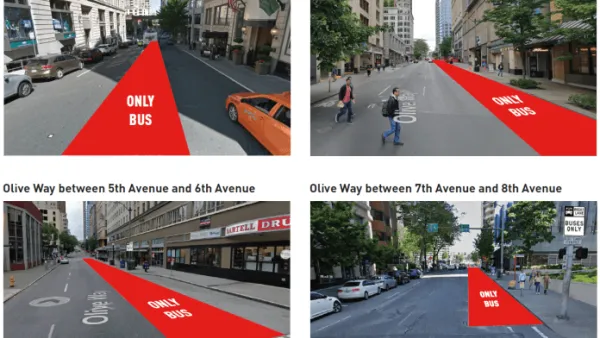
Seattle on a Roll With New Bus Lanes
A new plan to upgrade an existing bus lane in Seattle isn't the first and it probably won't be the last.

Desperate measures: Advocates weigh draining Lake Powell to fill Colorado River
Draining the reservoir could reduce evaporation losses by a couple hundred thousand acre-feet.

Eastern Nebraska is running out of electricity
Data centers and electrification are straining eastern Nebraska’s grid, throttling economic development.

Move over, LA: St. Louis gears up for Olympics, invests millions in downtown redevelopment
The Missouri city will host the 2028 Olympic soccer group stage and knockout matches.

California, Hawaii, Rhode Island approve housing propositions
Hawaii and Rhode Island each approved their sole proposition, while California approved two of its three.

Officials claim feds 'rushed' Amtrak environmental review
Amtrak plans to move their Chicago maintenance facility from an industrial area to a residential one.

NYC breaks ground on anti-flooding infrastructure project
New York City's new system will reduce stormwater flows to local sewers by 90%.

FREE Course: Walkable City 1: Why Walkability?
After describing his path towards focusing on walkability as the essence of good planning, Jeff Speck marches through his five principal reasons for making more walkable places.
Reinventing Malls: Planning Alchemy—Turning Gray Fields Into Gold
The course focuses on the opportunities and imperatives that shape reinvention of mall sites.

City of Rosemead
Rutgers University, Edward J. Bloustein School of Planning and Public Policy
One Hundred Miles
University of Michigan School for Environment and Sustainability (SEAS)
Hunter College, City University of New York (CUNY)
The Architects Foundation
City of Cambridge
Montrose County
The Pocatello Development Authority