As the Dallas City Council prepares to vote this month on a general fund budget, the future of bike lanes is not looking good.


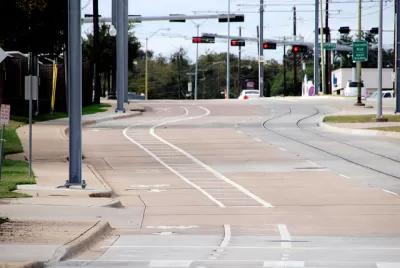
Robert Wilonsky reports on the Dallas City Council’s upcoming vote on a $1.35-billion general fund budget. This is an opportunity, says Wilonsky, to push forward what was outlined in the 2011 Dallas Bike Plan:
Right now, the city of Dallas spends just $500,000 every year on bike lanes, which does not stretch very far. City Manager T.C. Broadnax's budget proposes to double that in the coming fiscal year to a just-barely-less-lousy $1 million, and then to double that in two years so that, finally, we might inch closer to the 840-mile-long finish line promised by the bike plan.
Unfortunately, it looks like the council is more inclined to vote to eliminate funding for bike lanes, along with outside offices and additional staff support for council members. This is part of a plan to redirect funds to raises to keep police, firefighters, and paramedics from leaving for higher salaries in other counties.
Wilonsky laments this move because he says bike lane cuts will be minimal to the overall budget. In addition, he argues that the focus on public safety is not a new one and rather a means to chip away at other parts of the budget. “But these bike lanes are not some needless expense — like those council offices. They're not superfluous. They, too, are about public safety. Even if a majority of the council doesn't see it,” says Wilonsky.
Read the full story: Dallas City Council can't see that putting a few bucks toward bike lanes is public safety, too

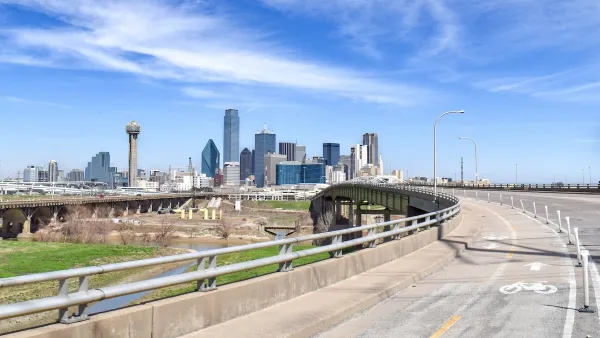
Dallas Bike Plan Calls for Accelerating Bike Infrastructure
City officials acknowledge Dallas lags behind in bicycle infrastructure, but a new plan could change that.

El Paso has Built 1,000 Miles of Bike Lanes in 10 Years
The city is now asking the public for input on updates to its bike plan.

San Antonio Leaders Look to Revive Dormant Bike Plan
The city’s 12-year-old plan to improve its bike network has made little headway. Now, city leaders hope to revitalize the effort.

Planetizen Federal Action Tracker
A weekly monitor of how Trump’s orders and actions are impacting planners and planning in America.

California plans to bury El Niño’s downpour
If the state plays its cards right, it may be able to store a billion acre-feet of El Niño’s water in aquifers.

Desperate measures: Advocates weigh draining Lake Powell to fill Colorado River
Draining the reservoir could reduce evaporation losses by a couple hundred thousand acre-feet.

California city breaks ground on transit connector
The project includes three mobility hubs and a pedestrian bridge.

After public outcry, Massachusetts city releases housing development tracker
Cambridge’s tracker currently shows 250 housing projects in various stages of development.

40 years after approval, Chicago breaks ground on new park
The park honors Jean Baptiste Point du Sable, the city’s first permanent non-native settler.

FREE Course: Walkable City 1: Why Walkability?
After describing his path towards focusing on walkability as the essence of good planning, Jeff Speck marches through his five principal reasons for making more walkable places.
Reinventing Malls: Planning Alchemy—Turning Gray Fields Into Gold
The course focuses on the opportunities and imperatives that shape reinvention of mall sites.

City of Rosemead
Rutgers University, Edward J. Bloustein School of Planning and Public Policy
One Hundred Miles
Hunter College, City University of New York (CUNY)
The Architects Foundation
University of Cincinnati Online
City of Cambridge
Montrose County
The Pocatello Development Authority