A new study concludes that not only is transit a safer way to travel, but communities oriented around transit are also safer. As a result, planning approaches that encourage transit also increase traffic safety.


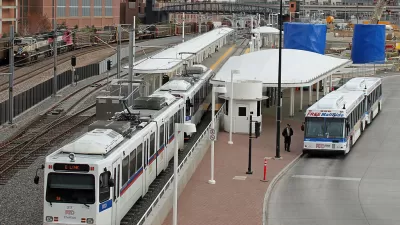
A new report [pdf] from the American Public Transportation Association looks at the relationship between public transit and traffic safety. The United States compared to peer countries ranks highest in terms of per capita vehicle mileage and traffic death rates. Among U.S. cities, the traffic fatality rate decreases as the number of per capita transit trips increases.
Angie Schmitt describes the report’s conclusion that factors related to public transit also increase traffic safety:
Transit is not only safer for the obvious reason — trains and buses are safer than cars — but because communities built around transit tend to have safer walking and biking amenities, fewer parking lots and safer street design. Such features, as well as higher population density, make it easier for people to make shorter car trips, or avoid them all together — reducing their overall exposure to crashes.
In addition, alternatives to driving, such as more available transit, promote less driving by high-risk groups, including youth, seniors, and alcohol drinkers, says APTA.
"APTA hopes the study will encourage increased transit funding. But the group also calls on cities and institutions to develop incentives — such as discounted fares — and disincentives, such as charging for parking by the day, to encourage drivers to switch to transit," reports Schmitt.
FULL STORY: The Best Tool for Reducing Traffic Deaths? More Transit!

Yes, another thing that car dependency makes worse: DUIs
In the land of the free (and the cars), design incites drinking and driving.
September Must-Reads: Top 10 Articles From Last Month
EV drivers can no longer use carpool lanes alone, Bay Area transit is saved — for now — by a $750 million loan, and a Florida commuter rail line loses its state subsidy, jeopardizing its future.
How Complete Streets Stands to Lose in the FY26 ‘Skinny Budget’
The President’s proposed budget could cut key resources for active transportation, public transit, and road safety programs.

Planetizen Federal Action Tracker
A weekly monitor of how Trump’s orders and actions are impacting planners and planning in America.

The state-sanctioned urbicide of Austin
People don’t kill cities. Freeways do.

US to reduce Colorado River water deliveries to Mexico
A new Colorado Treaty amendment reduces Mexico’s Colorado River water allocation by 250,000 acre feet.

5 New England states march closer to 800 megawatt wind energy project
Securing federal approval for the project may be complicated under the Trump administration, which has historically been hostile towards domestic wind power.

Baltimore to break ground on $50 million Transit Priority Project
The project will bring faster bus trips, safer streets and better bike connections to Baltimore.

Airbnb launches $250 million 'last-dollar financing' housing accelerator, makes first investment in Austin
The company will put $6.4 million towards affordable housing development in Texas’ capital.

FREE Course: Walkable City 1: Why Walkability?
After describing his path towards focusing on walkability as the essence of good planning, Jeff Speck marches through his five principal reasons for making more walkable places.
Reinventing Malls: Planning Alchemy—Turning Gray Fields Into Gold
The course focuses on the opportunities and imperatives that shape reinvention of mall sites.


Eagle County Government
Harvard University Graduate School of Design
Nashville Planning Department
The Architects Foundation
University of Cincinnati Online
The Pocatello Development Authority
The Urban Renewal Agency of the City of Pocatello
Journal of the American Planning Association