It might be the nation's most significant but least known congestion pricing plan. The plan originally recommended tolling all lanes on segments of two interstates. Four more roads were just added to broaden the plan.


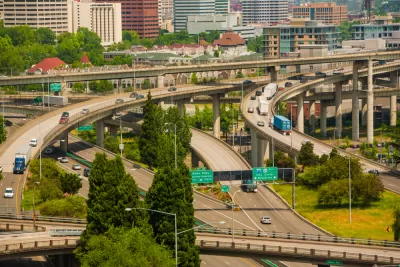
At its meeting in John Day on Thursday, the Oregon Transportation Commission (OTC) unanimously voted to accept the recommendations advanced last month by the Portland Metro Area Value Pricing Advisory Committee that centered on tolling Interstates 5 and 205 as these two highways are identified in the authorizing legislation, House Bill 2017, that created the congestion pricing program. [See committee's final report (pdf) dated July 5.]
According to its Aug. 16 press release, OTC directed the Oregon Department of Transportation (ODOT) to prepare an application to the Federal Highway Administration seeking approval to toll all lanes on two segments of the two interstates in a pilot program:
- All I-5 lanes between approximately Northeast Going Street/Alberta Street and Southwest Multnomah Boulevard, a stretch of about seven miles through the downtown Portland corridor.
- On or near the George Abernethy Bridge on Interstate 205 [between Oregon City and West Linn, Oregon].
The OTC will need to approve the application at its Nov. 16 meeting. "By law, the application must be submitted by December 31, 2018 [to FHWA]."
However, commissioners didn't stop there. Determined to prevent traffic diversion into neighborhoods, they expanded the tolling network in a separate action, reports Paris Achen, capital bureau reporter for The Portland Tribune:
Commissioners on Thursday authorized the Oregon Department of Transportation to analyze the feasibility of tolling I-5, I-205, Interstate 405, Interstate 84, U.S. Route 26, State Highway 217 and sections of U.S. Route 30. The tolled segments of each interstate would form a loop around the city to prevent diversion onto neighborhood streets and to maximize the reduction of congestion, said Commissioner Sean O'Hollaren.
"In my view you create a donut, a beltway, a loop that doesn't have gaps in it," O'Hollaren said. "I think you need to look at how do you make a complete loop around the Portland Metropolitan Area that prices that congestion and that we are looking very seriously to what alternatives people have to get around that same property. Are we incentivizing carpooling to the max, are we creating ways people can get around? I think that should be something we look at."
Twofold purpose
"Tolling could be used to both manage congestion and generate revenue to address highway bottlenecks, including by potentially funding the I-5 Rose Quarter and I-205 Stafford Road to Abernethy Bridge improvement projects," according to ODOT. However, toll revenue will not benefit public transit in the corridor.
The OTC also provided direction that any toll revenues from within the metro region be placed in a Congestion Relief Fund to invest in improvements to the transportation system in the region, as directed in HB 2017. The Oregon Constitution requires that any toll revenues be invested in roads.
Years away
"ODOT anticipates that it will be a number of years before tolling is implemented on Portland area freeways," notes the news release. In addition to needing federal approval, the project has generated local controversy, as one would expect from any project that adds pricing to driving. Challenges come from at least two fronts:
-
State voters would have to approve any tolling plan if an initiative sponsored by State Representative Mike Nearman (R-Independence), State Sen. Julie Parrish (R-Tualatin/West Linn) and Gladstone Planning Commissioner Les Poole qualifies for the 2020 ballot. "An initiative petition they've submitted to the state elections division would require a majority of Oregon voters (and a majority of voters in each county where the toll applies) is to sign off on any tolls on existing highways that aren't being expanded," reported Rachel Monahan for Willamette Week on Jul. 31.
-
On the opposite side of the Columbia River in the Portland region's largest suburb, Vancouver, Wash., a movement appears to be building to slower the momentum towards freeway tolling, particularly at the state line, led by Rep. Jaime Herrera Beutler, R-Battle Ground, Wash.
On the same day that OTC approved the tolling plan, Beutler announced that "she will introduce legislation [the as-yet unnumbered I-5 Corridor Cooperation Act] to prohibit tolls at the Washington-Oregon state line unless there is an agreement from the governors of both states," adds Achen of The Portland Tribune.
"Until Oregon formally scraps plans to toll I-5 and I-205 at the state line without providing a specific plan to benefit those who will pay, Washington commuters deserve to have a safeguard written into law that will protect them - and that's what my bill does," Herrera Beutler said in a statement.
Washington's Democratic governor, Jay Inslee, known for being a climate champion, appears to be opposed to the tolling plan.
Additional information:
- Watch the KOIN 6 news video on the plan and opposition to it accessible from the source article.
- Recent posts on the congestion pricing plan can be accessed from the legislative tag, HB 2017, plus:
-
"A Surprising Ally for Highway Tolling in Portland," August 2, 2018.
FULL STORY: OTC moves forward on tolling application

Interstate Highway Tolling Takes Major Step Forward in Pacific Northwest
The state that implemented the first gas tax and the first bike tax took a huge step on Thursday toward becoming the first, since 1956, to toll all lanes on an interstate highway by approving an application to the Federal Highway Administration.
Tolling of Portland Interstates Could Be Decided by Voters in 2020
Should plans to toll Interstates 5 and 205 in Portland get the go-ahead from the Oregon Transportation Commission and the Federal Highway Administration, they would still be subject to a state referendum.
Priced Lane or Priced Roadway?
The Pacific Northwest's Portland-Vancouver metropolitan area is studying options to add congestion pricing to one or two interstates.

The state-sanctioned urbicide of Austin
People don’t kill cities. Freeways do.

US to reduce Colorado River water deliveries to Mexico
A new Colorado Treaty amendment reduces Mexico’s Colorado River water allocation by 250,000 acre feet.

New Jersey’s second-largest city bans standalone data centers
Jersey City will continue to allow co-location facilities, such as those meant for research institutions that store their own data.

Amtrak not solely to blame for New Jersey commuter rail's unreliability, report finds
A new study from the Garden State Initiative found that NJ Transit’s budget grew 20% across a 4 year period, but reliability declined significantly over the same period.

EPA erases limits on planet-warming pollution from power plants
Under Monday’s plan, power plants would still have some limits on how much mercury, arsenic and other contaminants they can emit.

Phoenix announces new on-demand transit service, more frequent RAPID buses
Both new services will launch in October, and are part of Phoenix's Project Effective Access Solutions for Easing Congestion.

FREE Course: Walkable City 1: Why Walkability?
After describing his path towards focusing on walkability as the essence of good planning, Jeff Speck marches through his five principal reasons for making more walkable places.
Reinventing Malls: Planning Alchemy—Turning Gray Fields Into Gold
The course focuses on the opportunities and imperatives that shape reinvention of mall sites.

Eagle County Government
Harvard University Graduate School of Design
Nashville Planning Department
The Architects Foundation
University of Cincinnati Online
The Pocatello Development Authority
The Urban Renewal Agency of the City of Pocatello
Journal of the American Planning Association