The city will reduce vehicle lanes and build a protected multi-use trail including bioswales and other water retention features on its ‘secret highway.’


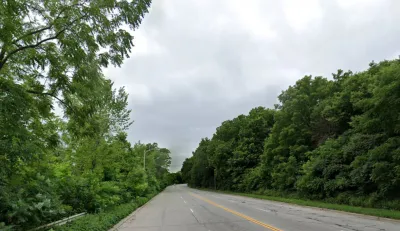
An underused stretch of a Milwaukee road will be transformed into “an environmentally and people-friendly corridor,” writes Jeramey Jannene in Urban Milwaukee.
The strip is located on 1st Street, sandwiched between the Kinnickinnic River and a steep hill. As Jannene explains, “There are no sidewalks or pedestrian accommodations to be found on the approximately half-mile, four-lane stretch, and there is little traffic. There are no homes or businesses. The only driveway is a chained-off ramp to a Deep Tunnel access point.” Now, the city has announced it will reduce vehicle lanes from four to two and add a 10-foot-wide pedestrian and bike path and bioswale.
The design will increase safety for pedestrians and cyclists and also improve drainage by reducing paved surface area. “The bioswales and other environmental features are expected to add almost 91,000 gallons of storm water storage capacity, and 40 trees are expected to be planted.”
The project is funded in part by grants from the Milwaukee Metropolitan Sewerage District and the National Fish and Wildlife Foundation’s Sustain Our Great Lakes program.
Read the full story: Milwaukee Will Shrink Its Secret Highway

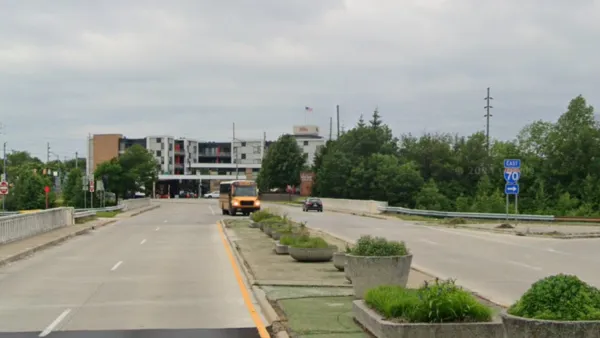
Indy Neighborhood Group Builds Temporary Multi-Use Path
Community members, aided in part by funding from the city, repurposed a vehicle lane to create a protected bike and pedestrian path for the summer season.
Milwaukee Announces 60 Traffic Calming Projects for 2025
The city has successfully reduced traffic deaths and aims to eliminate them completely within the next decade.
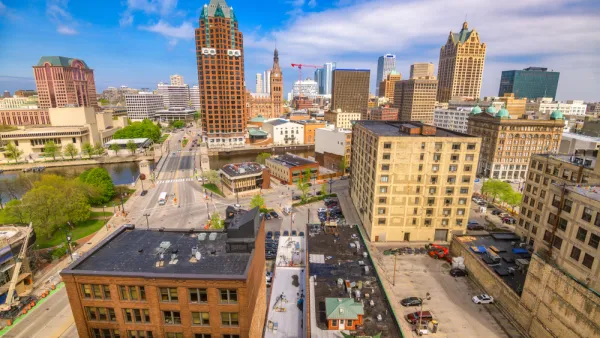
Milwaukee Traffic Safety Projects To Receive $8.5 Million in TIF Funds
The city hopes to combat a growing reckless driving 'crisis' with traffic calming, bike lanes, and other projects aimed at improving roadway safety.

Planetizen Federal Action Tracker
A weekly monitor of how Trump’s orders and actions are impacting planners and planning in America.

California plans to bury El Niño’s downpour
If the state plays its cards right, it may be able to store a billion acre-feet of El Niño’s water in aquifers.

Chicago breaks ground on $3 billion megadevelopment
The new neighborhood, titled Foundry Park, will one day host 3,700 residences.

Satanic Place Names
From streams and lakes to valleys and canyons, I mapped more than 1,000 places named after the Devil.

California High-Speed Rail Authority CEO resigns after $600,000 scandal
Under Ian Choudri, the authority used taxpayer dollars to fund first class flights and trips to nightclubs.

Want to study the Missouri River? Soon, you may need unanimous approval from 10 states
Legislation would require 10 governors’ permission to study or build projects moving water outside the basin.

FREE Course: Walkable City 1: Why Walkability?
After describing his path towards focusing on walkability as the essence of good planning, Jeff Speck marches through his five principal reasons for making more walkable places.
Reinventing Malls: Planning Alchemy—Turning Gray Fields Into Gold
The course focuses on the opportunities and imperatives that shape reinvention of mall sites.

City of Rosemead
Rutgers University, Edward J. Bloustein School of Planning and Public Policy
One Hundred Miles
Hunter College, City University of New York (CUNY)
The Architects Foundation
University of Cincinnati Online
City of Cambridge
Montrose County
The Pocatello Development Authority