Even in the nation’s third-largest EV market, a charger can be hard to find.


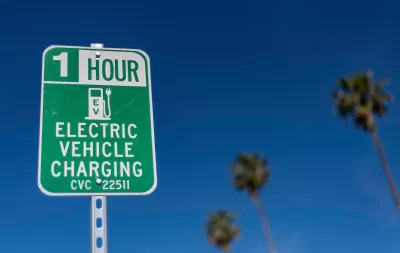
A new mapping tool reveals that sizable areas of Los Angeles are electric vehicle ‘charging deserts,’ reports Joann Muller in Axios.
“If a monster EV market like L.A. can't get public charging right, the rest of America is probably not doing much better,” Muller adds. “Nearly 588,000 EVs are registered in L.A. — about 4.2% of cars on the road there. In April, the most recent month available, EVs made up 21.5% of L.A.'s new car registrations.”
As Muller explains, “The tool pulls in a massive amount of data from up to 80 sources, including mobile phones, traffic, EV ownership, housing types, crime, etc.” and compares data to determine where EV owners are charging.
The ‘charging deserts’ are littered across the Los Angeles area and include Redondo Beach, Inglewood, and the campuses of UCLA and Cal State, Fullerton. “In Inglewood, for example, there are no public chargers — despite more than 1,000 registered EVs and 6,000 more passing through daily on I-405.”
Read the full story: Surprise: "Charging deserts" persist even in EV-crazed cities

Rivian Joins Movement Toward Universal EV Charging
As more automakers like Tesla, Ford, and Rivian make their charging infrastructure compatible, the shift could lead to the faster development of a nationwide EV charging network.

Florida wants to shift its entire EV charger budget to air taxi 'vertiports'
FDOT argues the private sector is already building out the state's fast-charging infrastructure, so the state could redirect those funds elsewhere.
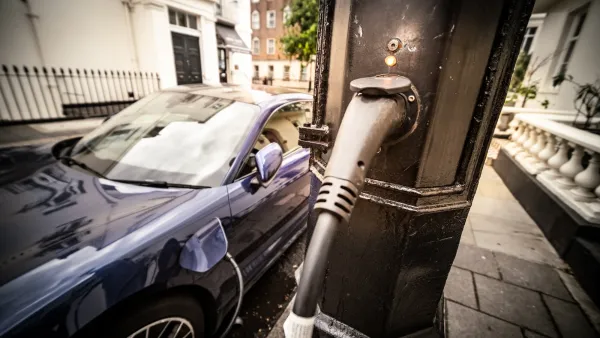
DC light poles will soon charge your electric car
The city awarded three grants to companies that will install more publicly available EV chargers.

Planetizen Federal Action Tracker
A weekly monitor of how Trump’s orders and actions are impacting planners and planning in America.

California plans to bury El Niño’s downpour
If the state plays its cards right, it may be able to store a billion acre-feet of El Niño’s water in aquifers.

Desperate measures: Advocates weigh draining Lake Powell to fill Colorado River
Draining the reservoir could reduce evaporation losses by a couple hundred thousand acre-feet.

Mamdani’s pied-à-terre tax survives legal challenge
A panel of judges found that the plaintiffs failed to demonstrate injury as a result of New York City's implementation of the tax.

Eastern Nebraska is running out of electricity
Data centers and electrification are straining eastern Nebraska’s grid, throttling economic development.

Seattle passes record-breaking transit services expansion
Proposition 1 will double the city’s transit tax to add 95,000 more bus trips and preserve 180,000 bus trips annually.

FREE Course: Walkable City 1: Why Walkability?
After describing his path towards focusing on walkability as the essence of good planning, Jeff Speck marches through his five principal reasons for making more walkable places.
Reinventing Malls: Planning Alchemy—Turning Gray Fields Into Gold
The course focuses on the opportunities and imperatives that shape reinvention of mall sites.

City of Rosemead
Rutgers University, Edward J. Bloustein School of Planning and Public Policy
One Hundred Miles
University of Michigan School for Environment and Sustainability (SEAS)
Hunter College, City University of New York (CUNY)
The Architects Foundation
City of Cambridge
Montrose County
The Pocatello Development Authority