The United States is conspicuously consistent in its high rates of car usage, a new analysis finds.


More than half of global commutes are now made by car, according to a new study from Complexity Science Hub. The study also highlights which parts of the world are most car-dependent and where public transit is most expansive.
The study examines close to 800 cities around the world. “Across regions, the percentage varies greatly, with almost 92% of journeys being made by automobile in cities in the US and Canada. The percentage of commutes by car in Northern and Southern European cities ranges from 50% to 75%.”
The article includes interactive visualizations of the data. The analysis shows that, while car ownership has grown, public transit accounts for a majority of commutes in many European and Asian cities, although rates vary widely.
“In contrast, the US exhibits minimal variation in modal share across cities of different sizes,” the researchers say. “As the study shows, in the United States and Canada, nearly 92% of commutes are made by car. Public transit makes up 4.6%, and active mobility makes up 3.5%.” New York City, unsurprisingly, has the highest transit mode share at 25 percent.
Read the full story: Over half of global commutes are by car, says study

In Defense of Car-light Planning
By framing car-free as the only way forward, we have made the perfect the enemy of the good. It’s time we emphasize — and promote — small progress.
What Would it Take to Ditch Your Car?
A conversation series from the National Trust for Historic Preservation asks what it would take for people to ditch their cars and rely solely on walking, cycling and public transportation.
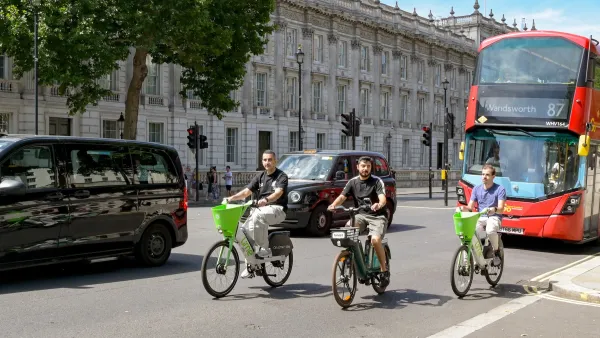
Bike use in London grew by 43% since 2019, but car use remains roughly the same
The city's efforts to reduce car use have stalled despite ambitious programs like congestion pricing and low-traffic neighborhoods.

Planetizen Federal Action Tracker
A weekly monitor of how Trump’s orders and actions are impacting planners and planning in America.

California plans to bury El Niño’s downpour
If the state plays its cards right, it may be able to store a billion acre-feet of El Niño’s water in aquifers.

Chicago breaks ground on $3 billion megadevelopment
The new neighborhood, titled Foundry Park, will one day host 3,700 residences.

City officials are dumping billions of gallons of sewage into the Chicago River
This year, the Racine Avenue sewage pumping station has poured over 10 billion gallons of sewage into the Chicago River.

Move over, LA: St. Louis gears up for Olympics, invests millions in downtown redevelopment
The Missouri city will host the 2028 Olympic soccer group stage and knockout matches.

Satanic place names
From streams and lakes to valleys and canyons, I mapped more than 1,000 places named after the Devil.

FREE Course: Walkable City 1: Why Walkability?
After describing his path towards focusing on walkability as the essence of good planning, Jeff Speck marches through his five principal reasons for making more walkable places.
Reinventing Malls: Planning Alchemy—Turning Gray Fields Into Gold
The course focuses on the opportunities and imperatives that shape reinvention of mall sites.

City of Rosemead
Rutgers University, Edward J. Bloustein School of Planning and Public Policy
One Hundred Miles
Hunter College, City University of New York (CUNY)
The Architects Foundation
University of Cincinnati Online
City of Cambridge
Montrose County
The Pocatello Development Authority