The legislation would expand eligibility for economic incentives and let cities loosen regulations to allow for more building conversions.


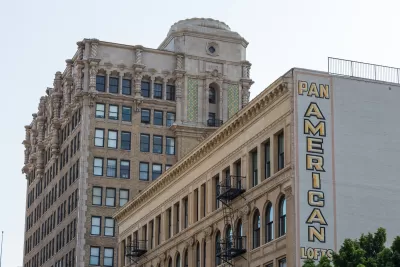
Two proposed California Assembly bills take aim at the housing supply through adaptive reuse, according to an article in Beverly Press. The bills aim to make the process of converting commercial buildings easier and less expensive.
Assembly Bill 2909 expands economic incentives for converting commercial buildings to housing. “Specifically, the bill would make buildings that are at least 30 years old and located in commercial zones eligible for Mills Act contracts and require that property tax savings be reinvested in retrofitting and repurposing existing buildings to create new residential rental units.”
Assembly Bill 2910 “enables jurisdictions that are designated as ‘pro-housing’ and are compliant with state housing laws to adopt alternative building regulations to make it easier to convert commercial and industrial buildings to residential units.”
In Los Angeles, an adaptive reuse ordinance adopted in 1999 helped bring 12,000 new residential units to the city’s downtown area.
Read the full story: California Assembly bills would make it easier to convert commercial buildings into housing

New Jersey affordable housing requirements spur infill development across the state
A 50-year-old law continues to reshape development around housing goals.
Co-living ‘Microapartments’ Cost Half as Much to Build as Typical Studios
In 10 major U.S. metros, an analysis found that converting office buildings to small co-living units could dramatically cut the costs of construction.
Office Conversion Sees No Sign of Slowing
The adaptive reuse of office buildings for residential and other uses will grow by as much as 63 percent in 2024 over last year.

Planetizen Federal Action Tracker
A weekly monitor of how Trump’s orders and actions are impacting planners and planning in America.

The state-sanctioned urbicide of Austin
People don’t kill cities. Freeways do.

Colorado’s Largest Data Center Could Rise Next to Homes — Without a Public Hearing
The proposed campus would consume 11 times the power of Denver International Airport; as it has across the country, opposition mounts.

Nation's most wind-powered state turns to coal as data centers increase energy demand
For the first time in decades, Iowa has increased its generation of coal power.

NYC cools commuters with city's first rain garden above a bus stop
New York City officials say the plants in the rain garden can absorb 16 gallons of rainwater during heavy storms.

Brightline West’s future may rely on $6 billion federal loan
The company has until Nov. 2 to make a $400 million equity investment into its proposed high-speed rail line.

FREE Course: Walkable City 1: Why Walkability?
After describing his path towards focusing on walkability as the essence of good planning, Jeff Speck marches through his five principal reasons for making more walkable places.
Reinventing Malls: Planning Alchemy—Turning Gray Fields Into Gold
The course focuses on the opportunities and imperatives that shape reinvention of mall sites.

Greater Baltimore Committee
Eagle County Government
Harvard University Graduate School of Design
The Architects Foundation
University of Cincinnati Online
The Pocatello Development Authority
The Urban Renewal Agency of the City of Pocatello
Journal of the American Planning Association