Culdesac Tempe has been welcoming residents since last year.


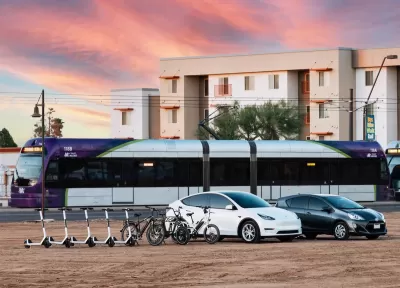
A new car-free development somewhat ironically dubbed Culdesac in Tempe, Arizona is starting to gain residents. As Robert English reports in The Cool Down, the Phoenix-adjacent community boasts no car parking and mixed-use development that puts many daily needs within easy reach of residents. “The developers hope to have around 1,000 people live in Culdesac by 2025, when their 760 units will be completed.”
As English points out, the development operates more like a large campus within the city of Tempe. While “Culdesac aims to eliminate the harmful effects of cars on the environment with climate-friendly housing while reuniting communities outside of the home and workplace,” it remains to be seen how many residents will need to commute to jobs and other needs farther outside the town—and how they’ll be able to get there.
Read the full story: The first car-free community built from scratch in the US is starting to take off: ‘For some, cars equal freedom, but for me, it’s a restriction’

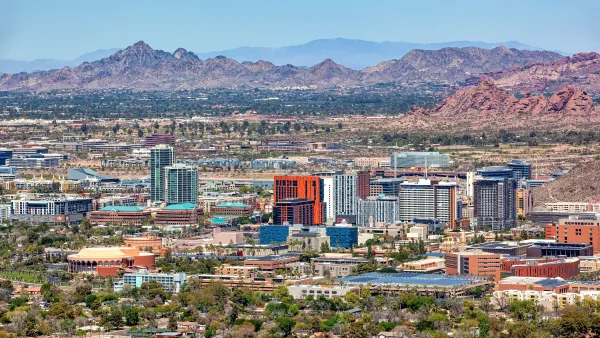
Arizona ‘Car-Free’ Neighborhood Nears Opening
Culdesac Tempe bans personal cars in exchange for access to scooters, bike facilities, and free transit. Is that enough to reduce car ownership in auto-centric Arizona?
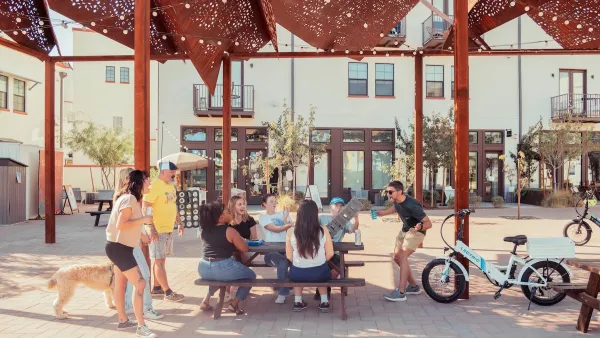
After Culdesac's success in Tempe, Mesa approves new 1,000-unit 'car-light' development
Culdesac Mesa will take the same transit-oriented approach with a compact, walkable design and access to transit and shared mobility options.
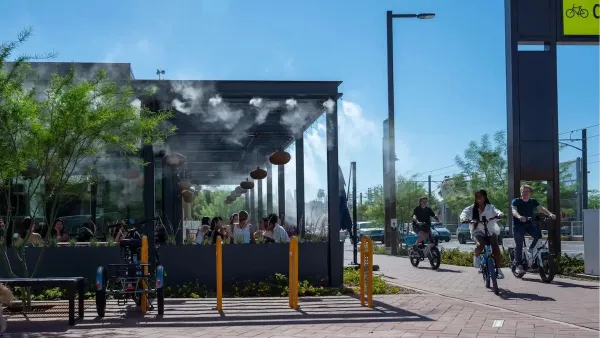
Car-Free Arizona Suburb Gains Residents
The project, dubbed Culdesac, offers EV rentals, free light rail passes, and other perks instead of private parking.

Planetizen Federal Action Tracker
A weekly monitor of how Trump’s orders and actions are impacting planners and planning in America.

California plans to bury El Niño’s downpour
If the state plays its cards right, it may be able to store a billion acre-feet of El Niño’s water in aquifers.

Desperate measures: Advocates weigh draining Lake Powell to fill Colorado River
Draining the reservoir could reduce evaporation losses by a couple hundred thousand acre-feet.

California High-Speed Rail Authority picks trainset manufacturer
The California High-Speed Rail Authority aims to start servicing passengers by 2033.

LA may place emergency ban on karaoke room permits
If Councilwoman Heather Hutt’s proposal passes, the moratorium would last between 45 days and one year.

City officials are dumping billions of gallons of sewage into the Chicago River
This year, the Racine Avenue sewage pumping station has poured over 10 billion gallons of sewage into the Chicago River.

FREE Course: Walkable City 1: Why Walkability?
After describing his path towards focusing on walkability as the essence of good planning, Jeff Speck marches through his five principal reasons for making more walkable places.
Reinventing Malls: Planning Alchemy—Turning Gray Fields Into Gold
The course focuses on the opportunities and imperatives that shape reinvention of mall sites.

City of Rosemead
Rutgers University, Edward J. Bloustein School of Planning and Public Policy
One Hundred Miles
Hunter College, City University of New York (CUNY)
The Architects Foundation
University of Cincinnati Online
City of Cambridge
Montrose County
The Pocatello Development Authority