The city updated its pandemic-era on-street dining program with new regulations that limit the locations and design of parklets.



According to an article in Edhat Santa Barbara, the city council approved a new set of regulations governing parklets, or ‘temporary outdoor business areas,’ located on city land in a 5-2 vote.
The new process comes with a $514 pre-application fee, but locations within the Coastal Zone will be subject to a $5,535 application fee.
“Parklets will be limited to the parking space(s) entirely within the frontage of the business operating the parklet. If a parking space straddles the line between two businesses, then it cannot be used for a parklet unless both businesses share the parklet.” Parklets can’t block drainage or other key infrastructure and must be encircled by concrete K-rail.
The two opposing city council members expressed concern, one for the safety of customers, another about the aesthetic value of the K-rails designed to improve safety. Since the start of the pandemic and the growth of parklets in public right-of-way, there have been four vehicle collisions with parklets.
FULL STORY: Santa Barbara City Council Adopts Citywide Parklet Program

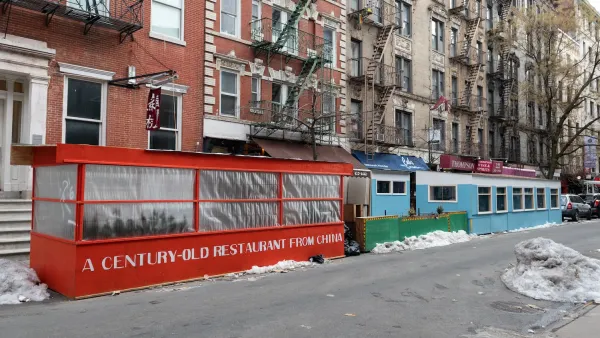
NYC Outdoor Dining Could Get a Re-Do
The city council is considering making the al fresco dining program year-round to address cost concerns from small businesses.

NYC Losing Many Outdoor Dining Areas Due to Expensive New Regulations
Restaurant owners say the city’s new outdoor dining program makes it too difficult and expensive to operate al fresco setups.

How Park(ing) Day Leads to Permanent Change
Small-scale interventions can lead the way to major parking reforms.

The state-sanctioned urbicide of Austin
People don’t kill cities. Freeways do.

US to reduce Colorado River water deliveries to Mexico
A new Colorado Treaty amendment reduces Mexico’s Colorado River water allocation by 250,000 acre feet.

New Jersey’s second-largest city bans standalone data centers
Jersey City will continue to allow co-location facilities, such as those meant for research institutions that store their own data.

Amtrak not solely to blame for New Jersey commuter rail's unreliability, report finds
A new study from the Garden State Initiative found that NJ Transit’s budget grew 20% across a 4 year period, but reliability declined significantly over the same period.

EPA erases limits on planet-warming pollution from power plants
Under Monday’s plan, power plants would still have some limits on how much mercury, arsenic and other contaminants they can emit.

Phoenix announces new on-demand transit service, more frequent RAPID buses
Both new services will launch in October, and are part of Phoenix's Project Effective Access Solutions for Easing Congestion.

FREE Course: Walkable City 1: Why Walkability?
After describing his path towards focusing on walkability as the essence of good planning, Jeff Speck marches through his five principal reasons for making more walkable places.
Reinventing Malls: Planning Alchemy—Turning Gray Fields Into Gold
The course focuses on the opportunities and imperatives that shape reinvention of mall sites.

Eagle County Government
Harvard University Graduate School of Design
Nashville Planning Department
The Architects Foundation
University of Cincinnati Online
The Pocatello Development Authority
The Urban Renewal Agency of the City of Pocatello
Journal of the American Planning Association