Emerging from a years-long drought, the state now faces significant flood risks as temperatures rise and the abundant snowpack begins to melt.


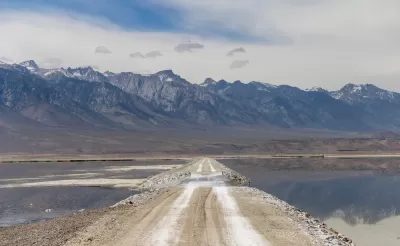
After a historic winter snow season, California’s Owens Valley is bracing for widespread flooding as the snowpack melt is expected to bring roughly 130 billion gallons of water via the Los Angeles Aqueduct alone.
According to an article by Louis Sahagún in the Los Angeles Times, “L.A.’s water lifeline to the Owens Valley has never before faced such a long-term flood threat. The vulnerability of the century-old system was brought into sharp focus on March 10, when storm flooding destroyed a 120-foot section of the aqueduct near Olancha.”
The unexpected breach—the first in the aqueduct’s history—highlighted the vulnerability of the Los Angeles water system, threatening supplies to 4 million LADWP ratepayers. Sahagún describes the strained relationship of the Los Angeles Aqueduct and the Owens Valley, where, in the early 20th century, the growing city illicitly bought land to build the aqueduct that would eventually lead to the demise of Owens Lake and have far-reaching impacts on the state’s ecology.
“Under a court order, the DWP has spent more than $2.5 billion over the last three decades transforming the lake’s grim heritage with dust control projects including shallow flooding that have reduced salty, alkaline toxic dust emissions by nearly 100%.” The lake bed now also draws tens of thousands of migratory birds that feed on local brine flies.
Read the full story: L.A.’s water lifeline faces unprecedented flood threat. The battle to prevent calamity

Southern California's Water Conservation and Storage Efforts Paying Off
The region has poured over a billion dollars into storage infrastructure and demand management policies in anticipation of worsening drought conditions.
Designing Permeable Cities for Drought Resilience
Take a kayak trip on the Los Angeles River with KQED science reporter Amy Standen to understand why cities were built on the premise of endless potable water and how we can build cities sustainably in regions that receive low rainfall.
Settling the Dust in the Owens Valley
After years of feud between Los Angeles and the Great Basin Unified Air Pollution Control District, a more sustainable deal has been reached to eradicate the toxic dust storms plaguing Owens Valley.

Planetizen Federal Action Tracker
A weekly monitor of how Trump’s orders and actions are impacting planners and planning in America.

The state-sanctioned urbicide of Austin
People don’t kill cities. Freeways do.

US to reduce Colorado River water deliveries to Mexico
A new Colorado Treaty amendment reduces Mexico’s Colorado River water allocation by 250,000 acre feet.

Nation's most wind-powered state turns to coal as data centers increase energy demand
For the first time in decades, Iowa has increased its generation of coal power.

NYC cools commuters with city's first rain garden above a bus stop
New York City officials say the plants in the rain garden can absorb 16 gallons of rainwater during heavy storms.

Brightline West’s future may rely on $6 billion federal loan
The company has until Nov. 2 to make a $400 million equity investment into its proposed high-speed rail line.

FREE Course: Walkable City 1: Why Walkability?
After describing his path towards focusing on walkability as the essence of good planning, Jeff Speck marches through his five principal reasons for making more walkable places.
Reinventing Malls: Planning Alchemy—Turning Gray Fields Into Gold
The course focuses on the opportunities and imperatives that shape reinvention of mall sites.

Greater Baltimore Committee
Eagle County Government
Harvard University Graduate School of Design
The Architects Foundation
University of Cincinnati Online
The Pocatello Development Authority
The Urban Renewal Agency of the City of Pocatello
Journal of the American Planning Association