Among the options on the table for the Southside Complete Streets Project is a configuration that would turn Telegraph Avenue near the campus of UC Berkeley into a pedestrian, bike, and transit-only plaza.


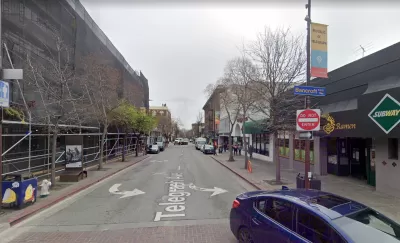
The blocks of Telegraph Avenue nearest to the campus of the University of California, Berkeley could soon be reconfigured to block cars, raise the street to the level of its sidewalks, and create transit bus lanes and improved pedestrian and bike infrastructure, reports Katie Lauer for the Mercury News in an article that might be paywalled for some readers.
The Southside Complete Streets Project aspires to create a "Times Square of the West" along the bustling corridor, which currently achieves its vibrancy despite one-way car traffic than ends when the street meets the campus near Sproul Plaza and Sather Gate.
According to Lauer, "the redesign will feature dedicated bus lanes, protected bike paths, widened sidewalks, improved pedestrian crossings and public transit stops. The purpose is to reduce dangerous traffic collisions, improve local transit reliability and boost the economic and cultural vitality of the neighborhood..."
The car-free plan is one alternative in the project, which is still under study after receiving a preliminary green light from the Berkeley City Council.
"Although the car-free idea wasn’t originally on the table, city officials bought into it following public outreach last summer and a last-minute push by members of Telegraph for People, a student-driven advocacy group," reports Lauer.
More details on the various options on the table for the project, including street cross sections, are included in the source article below.
Read the full story: Berkeley: Plan may turn Telegraph Avenue into ‘West Coast’s Times Square’
Mamdani’s Budget Fails to Expand Open Streets, Breaking Campaign Promise
The proposed budget allocates $2 million to Summer Streets and Open Streets, less than the $2.1 million allocated by the Adams administration last year.

Paris Voters Approve More Car-Free Streets
Paris Mayor Anne Hidalgo says the city will develop a plan to close 500 streets to car traffic and add new bike and pedestrian infrastructure after a referendum on the proposal passed with 66 percent of the vote.

NYC Officials Announce Broadway Pedestrianization Project
Two blocks of the marquee street will become mostly car-free public spaces.

Planetizen Federal Action Tracker
A weekly monitor of how Trump’s orders and actions are impacting planners and planning in America.

California plans to bury El Niño’s downpour
If the state plays its cards right, it may be able to store a billion acre-feet of El Niño’s water in aquifers.

Desperate measures: Advocates weigh draining Lake Powell to fill Colorado River
Draining the reservoir could reduce evaporation losses by a couple hundred thousand acre-feet.

In Texas, data centers are swallowing promised parkland
Residents who moved to Taylor, Texas for a rural community now have to contend with three data centers in their backyard.

How a Chicago-sized wind farm beat the odds and powered on
The project spanned five presidential administrations and a standoff with a U.S. military base.

MTA gives itself 30 days to transform pit into basketball court
The site has been under construction since 2022; the city originally estimated it would finish the court in 2024.

FREE Course: Walkable City 1: Why Walkability?
After describing his path towards focusing on walkability as the essence of good planning, Jeff Speck marches through his five principal reasons for making more walkable places.
Reinventing Malls: Planning Alchemy—Turning Gray Fields Into Gold
The course focuses on the opportunities and imperatives that shape reinvention of mall sites.

City of Rosemead
Rutgers University, Edward J. Bloustein School of Planning and Public Policy
One Hundred Miles
Hunter College, City University of New York (CUNY)
The Architects Foundation
University of Cincinnati Online
City of Cambridge
Montrose County
The Pocatello Development Authority