The "A Better Red" project won the federal funding it needed from the federal Transit Administration's Capital Investment Grants program.


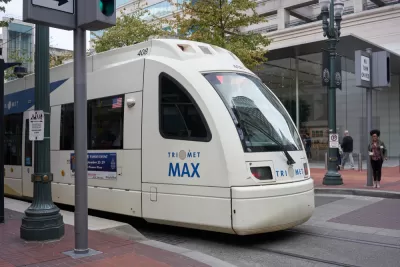
The U.S. Department of Transportation's Federal Transit Administration (FTA) announced late last week a Capital Investment Grants (CIG) award for the MAX Red Line Extension and Reliability Improvements Project in the Portland metropolitan area, according to an FTA press release.
The Tri-County Metropolitan Transportation District of Oregon (TriMet) is working on the "A Better Red" project—a 7.8-mile extension that will connect Beaverton, the Portland International Airport, and the Gateway Transit Center. "The Better Red project extends MAX Red Line west to serve 10 more stations and improves schedule reliability for the entire MAX system," according to the TriMet website for the project.
The grant funding will cover $99.9 million of the project's expected $215 million cost. With the funding in place, construction is scheduled to start near the Fair Complex/Hillsboro Airport Station and in the Gateway area in fall of this year, and at the Portland International Airport in early 2022. The new Red Line service in Beaverton and Hillsboro is scheduled to open in fall 2024.
"The project includes track, switch and signalization work that will allow the MAX Red Line to serve 10 additional stations that currently are served only by the Blue Line, and adds an operator break facility at the Red Line's new terminus in Hillsboro," according to the press release.
Read the full story: U.S. Department of Transportation Announces $99.9 Million Grant Award for the MAX Red Line Extension and Reliability Improvements Project in Portland, Oregon
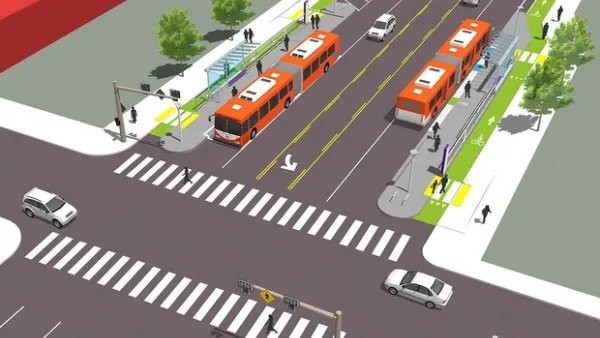
$1.36 Billion in Federal Transit Administration Grants Awarded
The Federal Transit Administration announced a new round of funding for the Capital Investment Grants program last week.

Portland gathers to pay respects to the last of its original light rail cars
The TriMet agency has fully replaced its aging fleet of Type 1 cars.
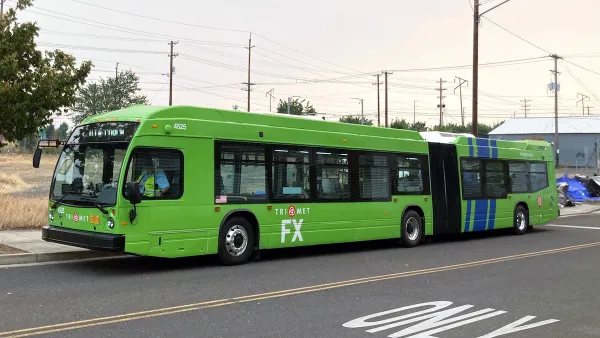
Portland ‘Frequent Express’ Bus Speeding Travel Times
TriMet’s newest line is improving service and reducing travel times for riders as ridership slowly recovers.

Planetizen Federal Action Tracker
A weekly monitor of how Trump’s orders and actions are impacting planners and planning in America.

California plans to bury El Niño’s downpour
If the state plays its cards right, it may be able to store a billion acre-feet of El Niño’s water in aquifers.

Desperate measures: Advocates weigh draining Lake Powell to fill Colorado River
Draining the reservoir could reduce evaporation losses by a couple hundred thousand acre-feet.

Los Angeles just elected an urban planner as its mayor
Transportation analysts are optimistic that Raman will be more aggressive in addressing transit issues than Bass.

Mamdani’s pied-à-terre tax survives legal challenge
A panel of judges found that the plaintiffs failed to demonstrate injury as a result of New York City's implementation of the tax.

Eastern Nebraska is running out of electricity
Data centers and electrification are straining eastern Nebraska’s grid, throttling economic development.

FREE Course: Walkable City 1: Why Walkability?
After describing his path towards focusing on walkability as the essence of good planning, Jeff Speck marches through his five principal reasons for making more walkable places.
Reinventing Malls: Planning Alchemy—Turning Gray Fields Into Gold
The course focuses on the opportunities and imperatives that shape reinvention of mall sites.

City of Rosemead
Rutgers University, Edward J. Bloustein School of Planning and Public Policy
One Hundred Miles
University of Michigan School for Environment and Sustainability (SEAS)
Hunter College, City University of New York (CUNY)
The Architects Foundation
City of Cambridge
Montrose County
The Pocatello Development Authority