A photographer documents the 'orphan wells' strewn across northwest Louisiana in a stark reminder of our deep entanglement with fossil fuels.


In a "series of photographs shot in the abandoned oil fields of Caddo Parish in northwest Louisiana," Meghan L.E. Kirkwood captures "the traces of an international economic and political system in which each one of us is stuck, a worldview in which profit comes to those who walk away," writes Daegan Miller in Places Journal.
When an oil well is no longer profitable, "the owners have a decision to make. They can plug the well, a job that can cost $30,000. Or, since Louisiana doesn’t require well operators to clean up their mess, they can abandon it to the public’s care. As of March 31, 2021, the state was home to 4,525 orphaned wells." But far from being drained dry, these wells "remain ruinously productive, belching methane, a greenhouse gas 84 times more effective than carbon dioxide at warming the planet, and leaking oil and brine into the aquifer, there to be taken up by all of us, human and non-human, who drink and bathe or make a home in or on the water."
Miller writes that "[Kirkwood's] photographs’ luminosity is an invitation to remember and, where memory fails, to imagine how thoroughly bound each of us is to oil, how thoroughly connected through it." They help us remember "that these are our landscapes, our orphans, our responsibilities."
Read the full story: Orphan Wells
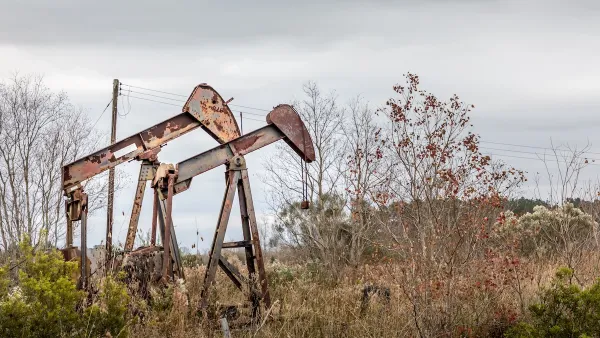
Addressing Orphan Wells for Environmental Justice
Remediating and repurposing some orphan oil and gas wells into parks can turn environmental hazards into community assets, promoting health, environmental justice, and accessible green space for underserved areas.
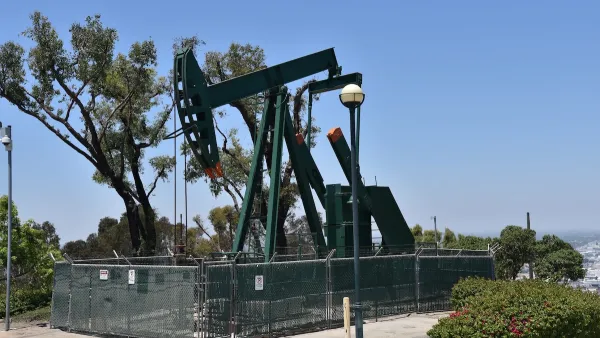
Governor Newsom Signs Bills to Restrict Oil and Gas Operations Near Communities
The signed legislation grants local communities more authority to restrict oil and gas operations near sensitive areas and address the environmental risks of idle wells, while also ensuring the permanent shutdown of low-production wells.
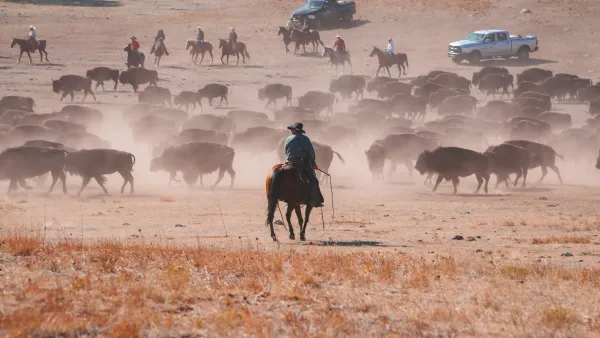
Feds want to stop notifying landowners about drilling under their land
The proposal also asks to reduce the public comment period for the BLM’s leasing decisions from 90 days to 10.

Planetizen Federal Action Tracker
A weekly monitor of how Trump’s orders and actions are impacting planners and planning in America.

California plans to bury El Niño’s downpour
If the state plays its cards right, it may be able to store a billion acre-feet of El Niño’s water in aquifers.

Desperate measures: Advocates weigh draining Lake Powell to fill Colorado River
Draining the reservoir could reduce evaporation losses by a couple hundred thousand acre-feet.

Mamdani’s pied-à-terre tax survives legal challenge
A panel of judges found that the plaintiffs failed to demonstrate injury as a result of New York City's implementation of the tax.

Eastern Nebraska is running out of electricity
Data centers and electrification are straining eastern Nebraska’s grid, throttling economic development.

Seattle passes record-breaking transit services expansion
Proposition 1 will double the city’s transit tax to add 95,000 more bus trips and preserve 180,000 bus trips annually.

FREE Course: Walkable City 1: Why Walkability?
After describing his path towards focusing on walkability as the essence of good planning, Jeff Speck marches through his five principal reasons for making more walkable places.
Reinventing Malls: Planning Alchemy—Turning Gray Fields Into Gold
The course focuses on the opportunities and imperatives that shape reinvention of mall sites.


City of Rosemead
Rutgers University, Edward J. Bloustein School of Planning and Public Policy
One Hundred Miles
University of Michigan School for Environment and Sustainability (SEAS)
Hunter College, City University of New York (CUNY)
The Architects Foundation
City of Cambridge
Montrose County
The Pocatello Development Authority