The state of Texas and the city of Austin are moving in opposite directions on how best to respond to the needs of people experiencing homelessness.


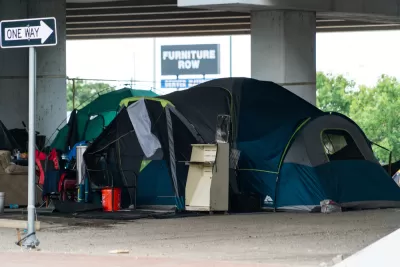
Juan Pablo Garnham reports: "The Texas Legislature is considering bills that would ban homeless encampments statewide, almost two years after the city of Austin decided to lift a similar local ban — a move that critics say triggered the proliferation of tent cities throughout Austin."
Garnham notes that the legislation is the latest attempt at state preemption on issues of public safety—lawmakers are also currently attempting to prevent local governments from cutting budget funding for police departments. Planetizen readers will also recall that the state also acted to preempt local red light camera programs.
Austin lifted its ban on public encampments in July 2019, according to Garnham. The City Council justified the decision at the time on the grounds that enforcing camping bans criminalized homelessness and worsened the cycles of poverty. "The proposed bills — HB 1925 and its companion, Senate Bill 987 — would make camping in an unapproved public place a Class C misdemeanor, punishable by a fine of up to $500," according to Garnham.

Austin Casts a Controversial Vote on Public Camping as the City Faces Growing Pains
Voters in Austin voted to reinstate a ban on public camping, taking steps to criminalize homelessness before the State Legislature could.

California Gives 15 Cities ‘Final Warning’ to Submit Mandatory Housing Plans
Communities are required to produce housing elements that accommodate sufficient housing for all income levels.

Arizona Court Rejects Local Control Over Short-Term Rentals
A judge upheld a 2017 law that prohibits local jurisdictions from limiting Airbnbs and other short-term rentals.

The state-sanctioned urbicide of Austin
People don’t kill cities. Freeways do.

US to reduce Colorado River water deliveries to Mexico
A new Colorado Treaty amendment reduces Mexico’s Colorado River water allocation by 250,000 acre feet.

New Jersey’s second-largest city bans standalone data centers
Jersey City will continue to allow co-location facilities, such as those meant for research institutions that store their own data.

Amtrak not solely to blame for New Jersey commuter rail's unreliability, report finds
A new study from the Garden State Initiative found that NJ Transit’s budget grew 20% across a 4 year period, but reliability declined significantly over the same period.

EPA erases limits on planet-warming pollution from power plants
Under Monday’s plan, power plants would still have some limits on how much mercury, arsenic and other contaminants they can emit.

Phoenix announces new on-demand transit service, more frequent RAPID buses
Both new services will launch in October, and are part of Phoenix's Project Effective Access Solutions for Easing Congestion.

FREE Course: Walkable City 1: Why Walkability?
After describing his path towards focusing on walkability as the essence of good planning, Jeff Speck marches through his five principal reasons for making more walkable places.
Reinventing Malls: Planning Alchemy—Turning Gray Fields Into Gold
The course focuses on the opportunities and imperatives that shape reinvention of mall sites.

Eagle County Government
Harvard University Graduate School of Design
Nashville Planning Department
The Architects Foundation
University of Cincinnati Online
The Pocatello Development Authority
The Urban Renewal Agency of the City of Pocatello
Journal of the American Planning Association