The Court Street corridor in Cincinnati is getting a comprehensive makeover, with money approved last week by the City Council.


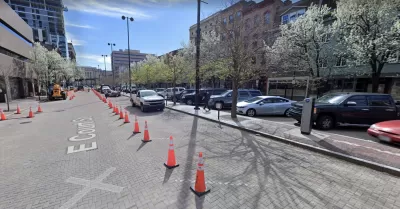
"Cincinnati City Council unanimously approved an $8.8 million project to revamp Court Street downtown between Vine and Walnut streets, widening the sidewalks and removing the median and some on-street parking to make the area more friendly to pedestrians," reports Chris Wetterich in a paywalled article.
An earlier article by Pat LaFleur and Kristen Swilley provides an open access look into the details of the project, as unveiled in late August to culminate the work of a task force convened by Mayor John Caranley in 2019.
"The current configuration includes one traffic lane in each direction, two parking lanes in each direction, and a narrow median separating the two. The new nearly $9 million design calls for eliminating the median and some of the parking in order to widen the sidewalk space on both the north and south side of the street," according to LaFleur and Swilley.
According to LaFleur and Swilley, the proposal has met some pushback from local businesses concerned about the lack of parking, but other businesses are seeking more foot traffic and outdoor dining space.
Read the full story: Here's what Downtown's Court Street could look like after 'pedestrianization' redesign

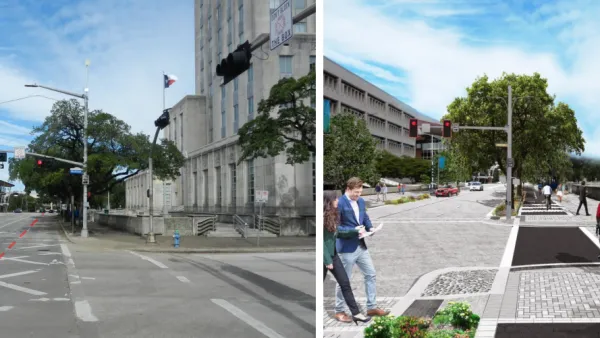
A Major Makeover for Houston Street
Bagby Street in Houston will soon have wider sidewalks and a new bike lane.

Bikelash Wins in Phoenix
Neighborhood opposition overwhelmed a plan to reduce the number of vehicles lanes on North Central Avenue to make space for a new bike lane, despite evidence of the benefits of the proposed street reconfiguration.

Opinion: 'Performative' Pedestrian Improvements Need Deeper Scrutiny
Minor pedestrian-oriented improvements alone won't improve walkability if infrastructure still prioritizes fast-moving vehicles, according to this article.

Planetizen Federal Action Tracker
A weekly monitor of how Trump’s orders and actions are impacting planners and planning in America.

California plans to bury El Niño’s downpour
If the state plays its cards right, it may be able to store a billion acre-feet of El Niño’s water in aquifers.

Desperate measures: Advocates weigh draining Lake Powell to fill Colorado River
Draining the reservoir could reduce evaporation losses by a couple hundred thousand acre-feet.

California city breaks ground on transit connector
The project includes three mobility hubs and a pedestrian bridge.

After public outcry, Massachusetts city releases housing development tracker
Cambridge’s tracker currently shows 250 housing projects in various stages of development.

40 years after approval, Chicago breaks ground on new park
The park honors Jean Baptiste Point du Sable, the city’s first permanent non-native settler.

FREE Course: Walkable City 1: Why Walkability?
After describing his path towards focusing on walkability as the essence of good planning, Jeff Speck marches through his five principal reasons for making more walkable places.
Reinventing Malls: Planning Alchemy—Turning Gray Fields Into Gold
The course focuses on the opportunities and imperatives that shape reinvention of mall sites.

City of Rosemead
Rutgers University, Edward J. Bloustein School of Planning and Public Policy
One Hundred Miles
Hunter College, City University of New York (CUNY)
The Architects Foundation
University of Cincinnati Online
City of Cambridge
Montrose County
The Pocatello Development Authority