Bagby Street in Houston will soon have wider sidewalks and a new bike lane.


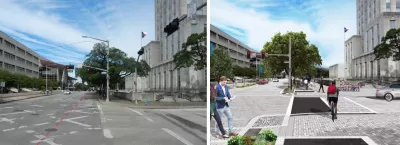
Dug Begley reports: "Bagby Street has seen better days. Now, with the new year underway, downtown-area officials are doing to the street what a lot of people promised for themselves in 2020: slimming down, fixing up and promising to put walking and biking front and center."
According to Bagley, traffic and recurring floods have damaged Bagby Street over the years. Already-old infrastructure has crumbled to a point that betrays the civic and historic value of the buildings that line the street, according to Bagby's sources.
Planners have been working on an upgrade for two years now, with plans to reduce vehicle lanes, widen sidewalks, and add a bike lane—a robust suite of complete streets and road diet changes.
The Houston Downtown Redevelopment Authority is funding the $28.8 million project, which was scheduled to begin construction on January 11. More details on the infrastructure improvements and construction schedule for the project are included in the article.
Read the full story: New year, new look for Bagby Street with bike lane, wider sidewalks

Houston Road Safety Project at Risk
Mayor Whitmire reversed his support for a planned road safety project that includes lane reductions, putting $40 million in federal funding in jeopardy.
Opinion: 'Performative' Pedestrian Improvements Need Deeper Scrutiny
Minor pedestrian-oriented improvements alone won't improve walkability if infrastructure still prioritizes fast-moving vehicles, according to this article.
Street Redesign as an Economic Development Tool
The city of Covington in Kentucky is working on street improvements on key downtown streets in the hopes of attracting new business to the area.

Planetizen Federal Action Tracker
A weekly monitor of how Trump’s orders and actions are impacting planners and planning in America.

California plans to bury El Niño’s downpour
If the state plays its cards right, it may be able to store a billion acre-feet of El Niño’s water in aquifers.

Desperate measures: Advocates weigh draining Lake Powell to fill Colorado River
Draining the reservoir could reduce evaporation losses by a couple hundred thousand acre-feet.

Chicago Avenue bridge construction delays enrages city leaders
The bridge has been closed since 2025. The city originally aimed to re-open it in December, and now expects to finish construction in 2027.

NYC bus network redesign speeds up Queens buses
Rush routes have seen a 4.6% speed increase after the redesign.

California High-Speed Rail Authority picks trainset manufacturer
The California High-Speed Rail Authority aims to start servicing passengers by 2033.

FREE Course: Walkable City 1: Why Walkability?
After describing his path towards focusing on walkability as the essence of good planning, Jeff Speck marches through his five principal reasons for making more walkable places.
Reinventing Malls: Planning Alchemy—Turning Gray Fields Into Gold
The course focuses on the opportunities and imperatives that shape reinvention of mall sites.

City of Rosemead
Rutgers University, Edward J. Bloustein School of Planning and Public Policy
One Hundred Miles
Hunter College, City University of New York (CUNY)
The Architects Foundation
University of Cincinnati Online
City of Cambridge
Montrose County
The Pocatello Development Authority