Facing a massive budget due to the declining revenues created by the coronavirus pandemic, California will have to cut a program intended to retrofit homes and roofs as a protection against wildfire, among other climate resilience programs.


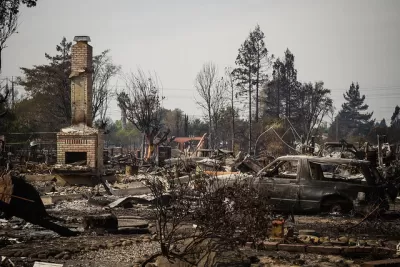
"Still recovering from devastating wildfires, California was poised to spend billions of dollars to prepare for future fires and other extreme weather disasters," according to an article by Lauren Sommer.
Then came the coronavirus, and "with a $54 billion budget deficit, the programs are being put on hold."
The state had planned on investing to "harden" existing homes as a defense against wildfire. Similar retrofitting programs had been piloted in parts of the state, but the state had planned on expanding those efforts.
"Last year, California lawmakers approved the first major statewide program for incentivizing such home-retrofits," according to Sommer. "In January, Governor Gavin Newsom announced $100 million in state and federal money to help homeowners replace roofs and make their homes more fire-resistant, particularly in low-income communities where upgrades may be out of reach for many." Newsom proposed a suspension of the program in May to help cover the costs of the state's growing budget deficit, in addition to other other climate resilience programs documented int he source article
FULL STORY: California Was Set To Spend Over $1 Billion to Prevent Wildfires. Then Came COVID-19


Rebuilding Smarter: How LA County Is Guiding Fire-Ravaged Communities Toward Resilience
Los Angeles County is leading a coordinated effort to help fire-impacted communities rebuild with resilience by providing recovery resources, promoting fire-wise design, and aligning reconstruction with broader sustainability and climate goals.
Retrofitting Old Cities for Sustainability
Explore strategies for retrofitting old cities to enhance sustainability while preserving historical integrity and managing logistical challenges.

Housing as a Climate Resilience Strategy
Ensuring that housing, including in informal settlements, is safe and healthy for its residents is a key tool in the fight to build more sustainable and equitable communities in the face of climate migration.

Planetizen Federal Action Tracker
A weekly monitor of how Trump’s orders and actions are impacting planners and planning in America.

The state-sanctioned urbicide of Austin
People don’t kill cities. Freeways do.

US to reduce Colorado River water deliveries to Mexico
A new Colorado Treaty amendment reduces Mexico’s Colorado River water allocation by 250,000 acre feet.

Brightline West’s future may rely on $6 billion federal loan
The company has until Nov. 2 to make a $400 million equity investment into its proposed high-speed rail line.

LA Metro’s ultimatum: no extra buses for LA28 if federal funding isn’t imminently secured
If Metro does not provide additional buses, LA28 organizers will have to find a new way to manage Olympic traffic. LA28’s budget does not include a line item for transit.

Colorado’s Largest Data Center Could Rise Next to Homes — Without a Public Hearing
The proposed campus would consume 11 times the power of Denver International Airport; as it has across the country, opposition mounts.

FREE Course: Walkable City 1: Why Walkability?
After describing his path towards focusing on walkability as the essence of good planning, Jeff Speck marches through his five principal reasons for making more walkable places.
Reinventing Malls: Planning Alchemy—Turning Gray Fields Into Gold
The course focuses on the opportunities and imperatives that shape reinvention of mall sites.

Eagle County Government
Harvard University Graduate School of Design
Nashville Planning Department
The Architects Foundation
University of Cincinnati Online
The Pocatello Development Authority
The Urban Renewal Agency of the City of Pocatello
Journal of the American Planning Association