Missouri lawmakers removed a barrier to the creation of a Hyperloop test facility in St. Louis.


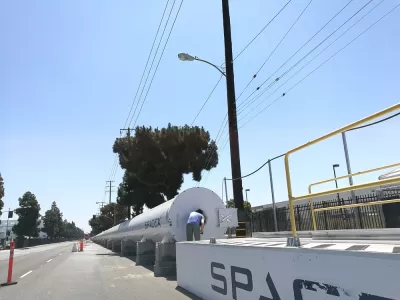
"Missouri lawmakers on Tuesday gave initial approval to a bill that would make a Hyperloop test track eligible for state grants," reports Jacob Kirn.
The legislation was necessary to clear the "tube transportation system" as permissible under the state's rules for public-private partnerships. St. Louis is hoping to continue advancing in a competition to "land a 12- to 15-mile test track and research center," according to Kirn. The city has already advance to the second round. Three to five cities are expected to advance to the third round.
Joseph Henry Enterprises LLC, the Economic Development Alliance, Economic Development Partnership, St. Louis Development Corp., and others are spearheading the effort to land the facility in St. Louis," according to an earlier article by Kirn.
Missouri assembled a task force to better compete for Hyperloop opportunities in March 2019.
An article by the Associated Press broke the news about the legislation.
[Editor's note: The archive of Hyperloop coverage on Planetizen is full of skepticism about the viability of the technology.]
Read the full story: State House passes Hyperloop bill


West Virginia Wins Bid for Location of Virgin Hyperloop Facility
Virgin Hyperloop's Hyperloop Certification Center (HCC) will be located on an 800-acre site straddling Tucker and Grant counties in West Virginia.
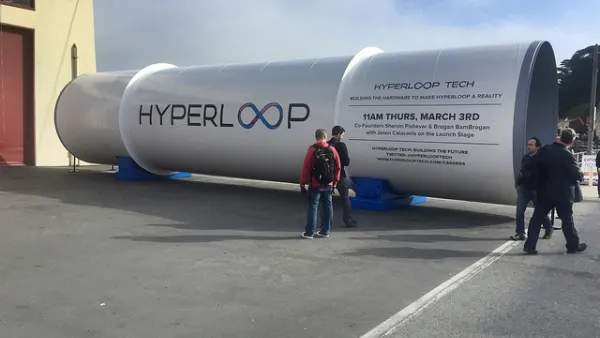
Eminent Domain Concerns Raised Over Missouri's Hyperloop Plans
Critics are pointing to a discrepancy between the plan and the reality in terms of how much private property must be acquired through eminent domain to make the state of Missouri's Hyperloop dreams come true.
Missouri Making Hyperloop Plans
Missouri state legislators have created a task force aimed at delivering a hyperloop route between Kansas City and St. Louis.

Planetizen Federal Action Tracker
A weekly monitor of how Trump’s orders and actions are impacting planners and planning in America.

The state-sanctioned urbicide of Austin
People don’t kill cities. Freeways do.

Colorado’s Largest Data Center Could Rise Next to Homes — Without a Public Hearing
The proposed campus would consume 11 times the power of Denver International Airport; as it has across the country, opposition mounts.

Nation's most wind-powered state turns to coal as data centers increase energy demand
For the first time in decades, Iowa has increased its generation of coal power.

NYC cools commuters with city's first rain garden above a bus stop
New York City officials say the plants in the rain garden can absorb 16 gallons of rainwater during heavy storms.

Brightline West’s future may rely on $6 billion federal loan
The company has until Nov. 2 to make a $400 million equity investment into its proposed high-speed rail line.

FREE Course: Walkable City 1: Why Walkability?
After describing his path towards focusing on walkability as the essence of good planning, Jeff Speck marches through his five principal reasons for making more walkable places.
Reinventing Malls: Planning Alchemy—Turning Gray Fields Into Gold
The course focuses on the opportunities and imperatives that shape reinvention of mall sites.

Greater Baltimore Committee
Eagle County Government
Harvard University Graduate School of Design
The Architects Foundation
University of Cincinnati Online
The Pocatello Development Authority
The Urban Renewal Agency of the City of Pocatello
Journal of the American Planning Association