Critics are pointing to a discrepancy between the plan and the reality in terms of how much private property must be acquired through eminent domain to make the state of Missouri's Hyperloop dreams come true.



"As much as 35 percent of the proposed route for Missouri’s ultra-fast Kansas City to St. Louis Hyperloop would require land acquisition through the government’s power of eminent domain, far more than boosters of the $10-billion venture have claimed," reports Edward McKinley
"The full feasibility report, completed last fall by the Kansas City-based firm Black & Veatch, is at odds with statements by supporters of the project, including Missouri House Speaker Elijah Haahr, who said last month that among the project’s selling points was that it could use 'a vast majority' of state-owned right-of-way along I-70," according to McKinley.
Eminent domain isn't popular in the state of Missouri. "On Tuesday, the House tentatively approved legislation blocking the use of eminent domain for the Grain Belt Express, a transmission line that would carry wind-generated electricity east across eight Missouri counties," according to McKinley.
FULL STORY: Missouri Hyperloop would require taking more private land than supporters say

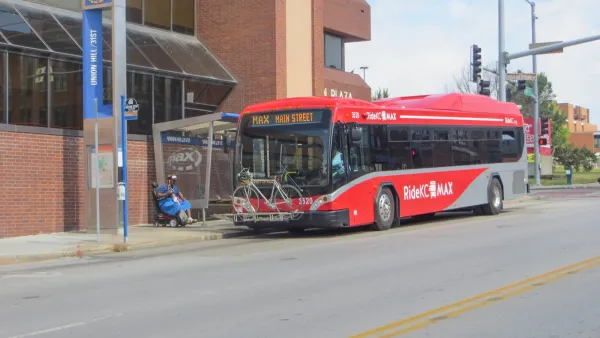
Draft RideKC Bus System Redesign Announced
The RideKC bus system is being redesigned on a high frequency grid.

Missouri Making Hyperloop Plans
Missouri state legislators have created a task force aimed at delivering a hyperloop route between Kansas City and St. Louis.
Planning in Earnest for a Hyperloop From Pittsburgh to Chicago
Funded studies of the hyperloop concept are underway in the Midwest.

The state-sanctioned urbicide of Austin
People don’t kill cities. Freeways do.

US to reduce Colorado River water deliveries to Mexico
A new Colorado Treaty amendment reduces Mexico’s Colorado River water allocation by 250,000 acre feet.

New Jersey’s second-largest city bans standalone data centers
Jersey City will continue to allow co-location facilities, such as those meant for research institutions that store their own data.

Amtrak not solely to blame for New Jersey commuter rail's unreliability, report finds
A new study from the Garden State Initiative found that NJ Transit’s budget grew 20% across a 4 year period, but reliability declined significantly over the same period.

EPA erases limits on planet-warming pollution from power plants
Under Monday’s plan, power plants would still have some limits on how much mercury, arsenic and other contaminants they can emit.

Phoenix announces new on-demand transit service, more frequent RAPID buses
Both new services will launch in October, and are part of Phoenix's Project Effective Access Solutions for Easing Congestion.

FREE Course: Walkable City 1: Why Walkability?
After describing his path towards focusing on walkability as the essence of good planning, Jeff Speck marches through his five principal reasons for making more walkable places.
Reinventing Malls: Planning Alchemy—Turning Gray Fields Into Gold
The course focuses on the opportunities and imperatives that shape reinvention of mall sites.

Eagle County Government
Harvard University Graduate School of Design
Nashville Planning Department
The Architects Foundation
University of Cincinnati Online
The Pocatello Development Authority
The Urban Renewal Agency of the City of Pocatello
Journal of the American Planning Association