A wheelchair user describes what it's like to travel on Atlanta streets and on the city's public transit system.



Jennifer Rainey Marquez is a disability advocate living in Atlanta who uses a power wheelchair to get around. She says as her muscular disorder progressed, she became more aware of how urban design affected her ability to navigate the city.
"In Atlanta, the sidewalks are really good in some places and really bad in others. There are sidewalk closures, missing curb cuts, and crumbling concrete. I push e-scooters out of the way or pick them up when they’re blocking sidewalks or curb ramps," says Marquez.
She also uses public transportation in Atlanta. The station elevators and accessible train platforms and bus ramps mean she is able to board vehicles and is not limited to particular routes or stops. For her, the MARTA system actually stands out in comparison to other cities. "In a lot of cities, the trains are older, the platforms are older, there’s no elevator," notes Marquez.
Read the full story: A disability advocate explains the joys—and challenges—of navigating Atlanta
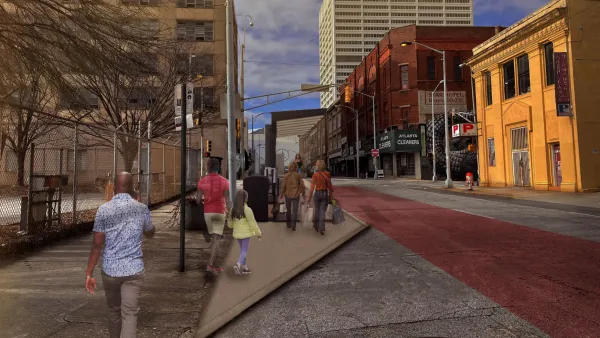
Atlanta's first BRT line opens April 18
MARTA officials say the line will operate like 'rail on rubber tires' and guarantee headways of 15 minutes or less.
MARTA’s NextGen Bus System to Relaunch With Increased Frequency, New Last-mile Rideshare Program
Atlanta’s transit agency will enhance service on some routes while compensating for service cuts on others with a new on-demand service.
MARTA To Add BRT Connection to Airport
A new rapid bus line in Atlanta will link residents to one of the nation’s busiest airports.

Desperate measures: Advocates weigh draining Lake Powell to fill Colorado River
Draining the reservoir could reduce evaporation losses by a couple hundred thousand acre-feet.

Eastern Nebraska is running out of electricity
Data centers and electrification are straining eastern Nebraska’s grid, throttling economic development.

Move over, LA: St. Louis gears up for Olympics, invests millions in downtown redevelopment
The Missouri city will host the 2028 Olympic soccer group stage and knockout matches.

Mass. votes against statewide minimum lot size for single-family homes
Over 2 million residents voted on Question 7; it was decided by just over 30,000 votes.

Maryland’s $15 billion bridge project gains key approval
The Maryland Transit Authority said the project will create over 60,000 jobs and add $23 billion to the local economy.

‘No clear next steps’ for Chicago's permanent festival grounds
Eleventh Ward Ald. Nicole Lee has suggested Soldier Field as a possible location for the permanent event space.

FREE Course: Walkable City 1: Why Walkability?
After describing his path towards focusing on walkability as the essence of good planning, Jeff Speck marches through his five principal reasons for making more walkable places.
Reinventing Malls: Planning Alchemy—Turning Gray Fields Into Gold
The course focuses on the opportunities and imperatives that shape reinvention of mall sites.

City of Rosemead
Rutgers University, Edward J. Bloustein School of Planning and Public Policy
One Hundred Miles
University of Michigan School for Environment and Sustainability (SEAS)
Hunter College, City University of New York (CUNY)
The Architects Foundation
City of Cambridge
The Pocatello Development Authority
The Urban Renewal Agency of the City of Pocatello