Rethinking the "brutalscape" of infrastructure that supports the suburbs could be the key to the evolution of suburbs.


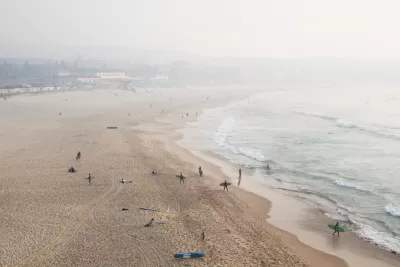
Paul J. Maginn and Roger Keil write on the subject of suburbs and their role in contributing to the causes of climate change, suggesting that planners and policy-makers need to focus attention and actions on the "brutalscape" of infrastructure that holds the whole suburban way of life together.
The article focuses on Australia and Canada, the home countries of the researchers, respectively, who wrote the article. The early brush fire season currently devastating Australia sets the context for the concern of the article.
"The growth of the suburban footprint of cities in Australia and Canada tests the limits of the sustainability of our present way of living in terms of energy use, transportation and provision of utilities," according to the article. The realities of sprawl requires a "suburban evolution" that requires an examination of "the ways in which life on the periphery is sustained"—i.e., not the suburban home.
Read the full story: The suburbs can help cities in the fight against climate change
FTA Kills ‘Social Cost of Carbon’ in Transit Grant Criteria
The Capital Investments Grant program will no longer factor in the future impacts of carbon emissions.
California’s Cap and Trade Program Up in the Air
The state’s carbon trading program is being attacked as ineffective from one side and overly onerous from the other.
The Small South Asian Republic Going all in on EVs
Thanks to one simple policy change less than five years ago, 65% of new cars in this Himalayan country are now electric.

Planetizen Federal Action Tracker
A weekly monitor of how Trump’s orders and actions are impacting planners and planning in America.

California plans to bury El Niño’s downpour
If the state plays its cards right, it may be able to store a billion acre-feet of El Niño’s water in aquifers.

Desperate measures: Advocates weigh draining Lake Powell to fill Colorado River
Draining the reservoir could reduce evaporation losses by a couple hundred thousand acre-feet.

US buildings threatened, destroyed by fires set to triple by 2060
Researchers found a high fire risk for socioeconomically vulnerable neighborhoods in the American West.

LA residents may be allowed to paint their own crosswalks
Councilwoman Katy Yaroslavsky put out a motion instructing the Los Angeles Department of Public Transportation to study the feasibility of allowing volunteers to paint crosswalks.

Dallas moves to overhaul its zoning code
The city's zoning reform will allow more multi-family and mixed-use developments.

FREE Course: Walkable City 1: Why Walkability?
After describing his path towards focusing on walkability as the essence of good planning, Jeff Speck marches through his five principal reasons for making more walkable places.
Reinventing Malls: Planning Alchemy—Turning Gray Fields Into Gold
The course focuses on the opportunities and imperatives that shape reinvention of mall sites.

City of Rosemead
Rutgers University, Edward J. Bloustein School of Planning and Public Policy
One Hundred Miles
Hunter College, City University of New York (CUNY)
The Architects Foundation
University of Cincinnati Online
City of Cambridge
Montrose County
The Pocatello Development Authority