Los Angeles County's Minh Le discusses the county's priorities for moving forward with recent technological advancements in solar and energy storage.



The Los Angeles County Board of Supervisors recently adopted its first countywide sustainability plan, OurCounty, addressing resilience, sustainability, and equity. Here, L.A. County Energy and Environmental Service’s General Manager Minh Le discusses the county's priorities for moving forward with technological advancements in solar and energy storage.
Le clarifies for readers how solar has become not only the environmentally-friendly choice, but also the most cost-effective choice for power procurement in the region, commenting:
"It doesn't make sense—sometimes on a fully depreciated capital asset standpoint—to operate a fossil fuel plant when the alternative is procuring solar and energy storage at 3.3 cents per kilowatt hour. That’s extremely aggressive pricing, and it's a testament to how far the industry has come."
Read the full interview and subscribe at The Planning Report.
Read the full story: LA County’s Minh Le on Scaling the Region’s New Energy Economy


Seven Brilliant Projects Keeping New Orleans Safe from Stormwater
20 years post Katrina, New Orleans has shored up and reinvented itself to absorb millions upon millions of gallons of stormwater. Their success holds lessons for landscape architects all over the world.

Rebuilding Smarter: How LA County Is Guiding Fire-Ravaged Communities Toward Resilience
Los Angeles County is leading a coordinated effort to help fire-impacted communities rebuild with resilience by providing recovery resources, promoting fire-wise design, and aligning reconstruction with broader sustainability and climate goals.
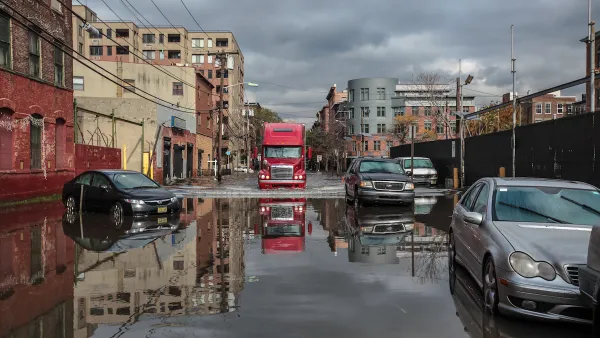
FEMA Resilience Program Cuts Grant Funding
The Building Resilient Infrastructure and Communities program funded projects from flood prevention to power station upgrades.

Planetizen Federal Action Tracker
A weekly monitor of how Trump’s orders and actions are impacting planners and planning in America.

Amtrak, CN end decades-long dispute with eight-year agreement
The new operating agreement establishes an updated framework for the companies to work together, including processes to resolve disputes.

Judges permit Denver to divert 77,000 acre feet from the Colorado River for reservoir expansion
Overuse and climate change have caused the Colorado River’s water levels to plummet.

Boston has spent millions making the Green Line more accessible — and there’s no end in sight
While the city has invested millions into expanding and adding platforms to the Green Line to make it more accessible, new train cars set to arrive next year will be too tall for disabled passengers to board without raising the current platforms.

Idaho may see an 18% drop in federal surface transit funding — the largest estimated cut in the US
Transit systems in rural communities are much more reliant on federal funding to provide their services.

How ‘post-disaster gentrification’ alters neighborhoods after natural calamities
After hurricanes, fires or other calamities, the original residents of a community are often replaced by younger, wealthier residents.

FREE Course: Walkable City 1: Why Walkability?
After describing his path towards focusing on walkability as the essence of good planning, Jeff Speck marches through his five principal reasons for making more walkable places.
Reinventing Malls: Planning Alchemy—Turning Gray Fields Into Gold
The course focuses on the opportunities and imperatives that shape reinvention of mall sites.

City of Wisconsin Rapids
Harvard University Graduate School of Design
KFH Group Inc.
The Architects Foundation
University of Cincinnati Online
The Pocatello Development Authority
The Urban Renewal Agency of the City of Pocatello