The city is expanding outreach to homeless people in order to move them off the subway and steer them toward housing and social services.


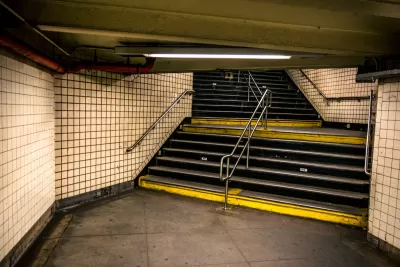
Katie Pyzyk reports that New York City plans to increase outreach to homeless people on the subway through the Homeless Outreach & Mobile Engagement Street Action Teams (HOME-STAT) initiative.
The HOME-STAT activities will include development of an interagency command center, an increase in outreach efforts, and a shared closed-circuit television feed to help teams with monitoring of the subway network.
"The initiatives are designed to get shelter and other supportive services to individuals experiencing homelessness, even if they have repeatedly refused those services in the past. The city's statements about the homeless solutions repeatedly reference efforts to get homeless people to 'accept services,'" says Pyzyk.
The New York Police Department also launched a Subway Diversion Project in June, an initiative that seeks to steer homeless people to outreach services and support programs.
Read the full story: BRIEF NYC steps up outreach to homeless using subway as shelter
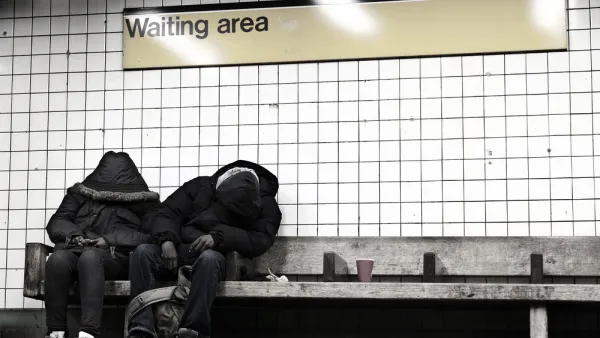
A New—and Hopefully Better—Way to Deal with the Homeless Crisis on the N.Y.C. Subway
More homeless people are using the subway as temporary housing, and the delays and disruptions have increased as well. A new city program will replace fines with outreach to provide better access to social services.
How "Train Nerds" Saved NYC's Subway from Sandy
It took an effort that was both well-planned and ad-hoc to save NYC's backbone from Hurricane Sandy, and have the city's transit system back up and running again soon after the storm. Robert Sullivan examines that effort and what happens next time.
MTA looks to bring AI-assisted, multilingual announcement system to subways
Some of the transit agency’s audio systems haven’t been upgraded in 40 years.

Planetizen Federal Action Tracker
A weekly monitor of how Trump’s orders and actions are impacting planners and planning in America.

California plans to bury El Niño’s downpour
If the state plays its cards right, it may be able to store a billion acre-feet of El Niño’s water in aquifers.

Desperate measures: Advocates weigh draining Lake Powell to fill Colorado River
Draining the reservoir could reduce evaporation losses by a couple hundred thousand acre-feet.

Mamdani’s pied-à-terre tax survives legal challenge
A panel of judges found that the plaintiffs failed to demonstrate injury as a result of New York City's implementation of the tax.

Eastern Nebraska is running out of electricity
Data centers and electrification are straining eastern Nebraska’s grid, throttling economic development.

Seattle passes record-breaking transit services expansion
Proposition 1 will double the city’s transit tax to add 95,000 more bus trips and preserve 180,000 bus trips annually.

FREE Course: Walkable City 1: Why Walkability?
After describing his path towards focusing on walkability as the essence of good planning, Jeff Speck marches through his five principal reasons for making more walkable places.
Reinventing Malls: Planning Alchemy—Turning Gray Fields Into Gold
The course focuses on the opportunities and imperatives that shape reinvention of mall sites.

City of Rosemead
Rutgers University, Edward J. Bloustein School of Planning and Public Policy
One Hundred Miles
University of Michigan School for Environment and Sustainability (SEAS)
Hunter College, City University of New York (CUNY)
The Architects Foundation
City of Cambridge
Montrose County
The Pocatello Development Authority