More homeless people are using the subway as temporary housing, and the delays and disruptions have increased as well. A new city program will replace fines with outreach to provide better access to social services.


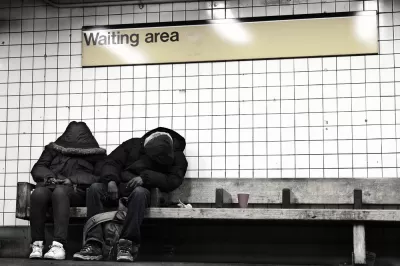
Winnie Hu reports that a new initiative in New York City called the Subway Diversion Project seeks to connect homeless people on transit with social services rather than giving them civil summonses that come with fines.
As the number of homeless people on the subway has increased, so have delays. "Trains were delayed 659 times last year by homeless people walking on tracks, blocking train doors and engaging in other unruly behavior — a 54 percent increase from the 428 such delays in 2014, according to the Metropolitan Transportation Authority, which runs the subway," writes Hu.
This new approach will involve waiving the summonses if individuals leave with outreach workers who can do assessments and help plug people into a network of social services. But homeless advocates say the program is not offering any new resources and the focus instead should be on providing the housing and services needed to get homeless people off the streets.
City and transit officials say the program is part of a larger effort to help the city’s homeless population. "Mr. [Andy] Byford, the transit chief, said the new program aimed to help vulnerable people while also balancing their needs against the needs of millions of subway riders," notes Hu.
FULL STORY: How Subway Delays and the Homeless Crisis Are Intertwined

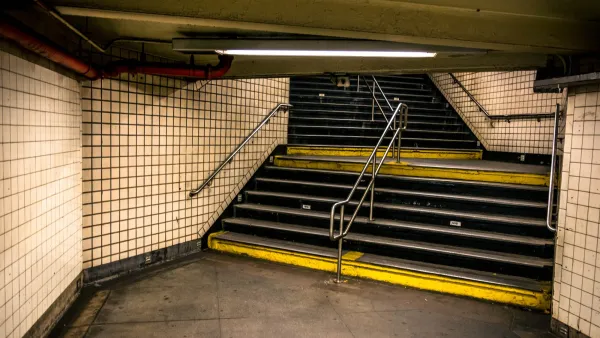
N.Y.C. Initiative Seeks to Connect Homeless on Transit with Social Services
The city is expanding outreach to homeless people in order to move them off the subway and steer them toward housing and social services.
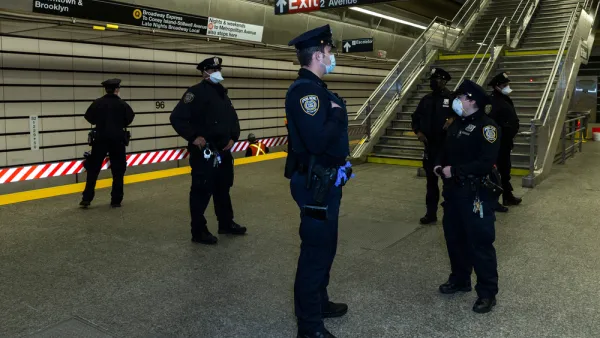
More Unhoused New Yorkers Died in 2021 Than in any Prior Year
New York City saw its deadliest year for people living in shelters or public spaces, with the pandemic and a rise in deadly overdoses fueling a fatal epidemic.
New York Still Not Tracking Vacancies
Despite de Blasio's campaign promises, the city of New York still doesn't count vacant properties, a negligence that advocates for the homeless have been fighting for years.

Planetizen Federal Action Tracker
A weekly monitor of how Trump’s orders and actions are impacting planners and planning in America.

The state-sanctioned urbicide of Austin
People don’t kill cities. Freeways do.

US to reduce Colorado River water deliveries to Mexico
A new Colorado Treaty amendment reduces Mexico’s Colorado River water allocation by 250,000 acre feet.

Baltimore to break ground on $50 million Transit Priority Project
The project will bring faster bus trips, safer streets and better bike connections to Baltimore.

Airbnb launches $250 million 'last-dollar financing' housing accelerator, makes first investment in Austin
The company will put $6.4 million towards affordable housing development in Texas’ capital.

Guerilla urbanists are building DIY bus stop benches in Chicago
A before-and-after of one of the bus stops with a new bench. The new benches are not officially sanctioned or permitted, but the residents who placed them hope they will be the start of a network of DIY benches across the city.

FREE Course: Walkable City 1: Why Walkability?
After describing his path towards focusing on walkability as the essence of good planning, Jeff Speck marches through his five principal reasons for making more walkable places.
Reinventing Malls: Planning Alchemy—Turning Gray Fields Into Gold
The course focuses on the opportunities and imperatives that shape reinvention of mall sites.

Eagle County Government
Harvard University Graduate School of Design
Nashville Planning Department
The Architects Foundation
University of Cincinnati Online
The Pocatello Development Authority
The Urban Renewal Agency of the City of Pocatello
Journal of the American Planning Association